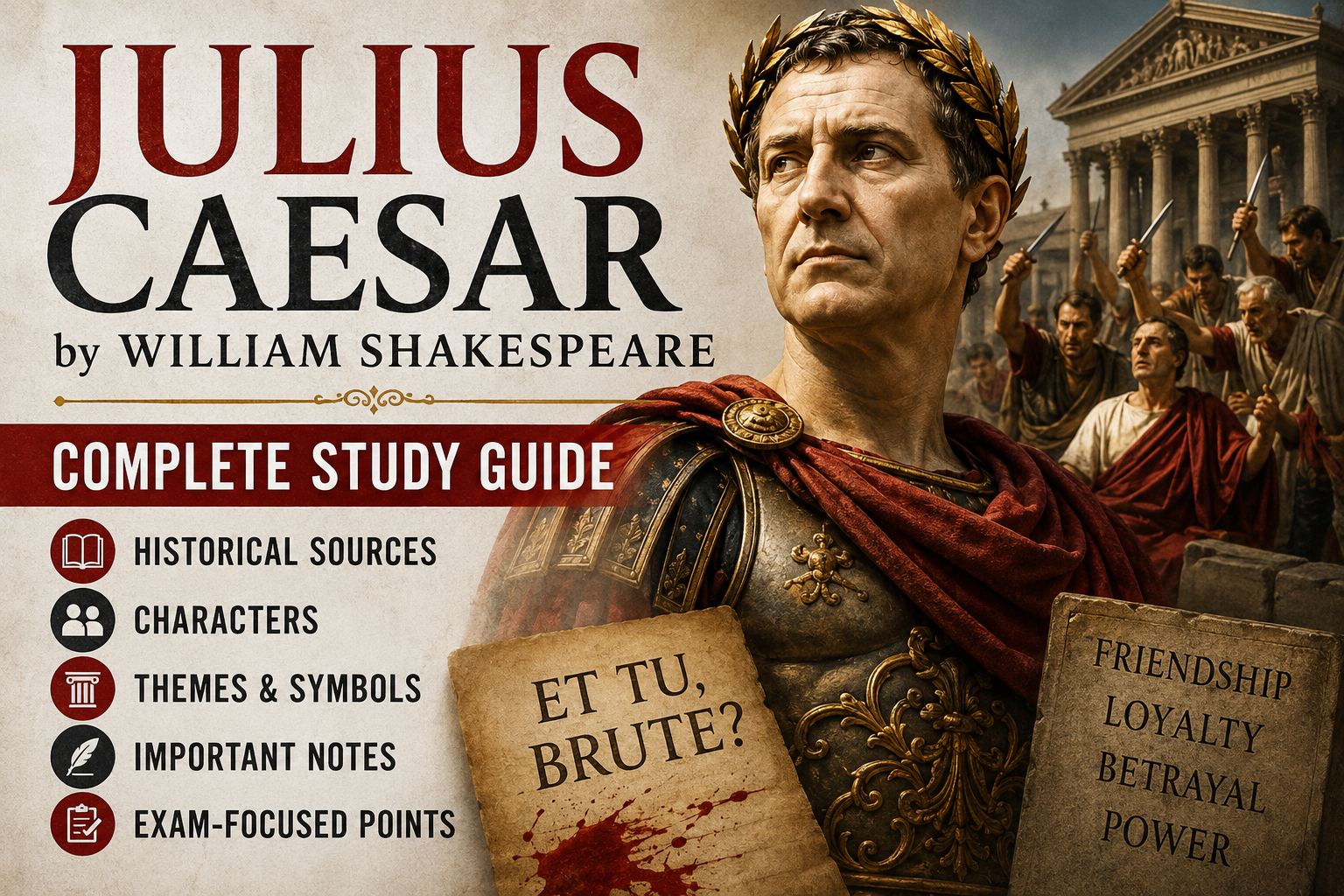
Julius Caesar is one of William Shakespeare’s most celebrated historical tragedies. Based on real events from ancient Rome, the play explores politics, ambition, loyalty, betrayal, power, and the consequences of assassination. It remains a popular text for literature students because of its timeless themes and memorable characters.
This guide summarizes the essential points from the study material, making it easier for students to revise for exams and understand the play in depth.
Historical Background of Julius Caesar
The assassination of Julius Caesar is considered one of the most significant events in world history.
Key Facts
- Julius Caesar was a Roman general and statesman.
- His assassination changed Roman politics forever.
- The event marked the decline of the Roman Republic.
- It became a symbol of political betrayal and power struggles.
- Shakespeare transformed this historical incident into a powerful tragedy.
Primary Source of Shakespeare’s Julius Caesar
The most important source used by Shakespeare was North’s Plutarch.
Important Details
- Shakespeare relied mainly on Plutarch’s Lives.
- He used Sir Thomas North’s English translation.
- The translation was first published in 1579.
- The second edition (1595) is believed to be the version Shakespeare consulted.
- North translated from Jacques Amyot’s French version rather than directly from Greek.
Why North’s Plutarch Was Important
- Rich example of Elizabethan prose.
- Famous for its natural English style.
- Contained detailed historical biographies.
- Helped Shakespeare develop realistic characters and historical events.
How Shakespeare Used Plutarch
Shakespeare followed Plutarch very closely throughout the play.
He borrowed:
- Overall storyline
- Historical events
- Character descriptions
- Political conflicts
- Famous speeches
- Several phrases and expressions
Examples
- Caesar’s epilepsy
- Omens before Caesar’s death
- Anonymous letters received by Brutus
- Cassius’ “lean and hungry look”
- Antony’s personality and political skill
Rather than copying history directly, Shakespeare added dramatic intensity and emotional depth.
Major Themes in Julius Caesar
1. Ambition
Personal ambition drives many characters.
- Caesar’s growing power worries Rome.
- Cassius fears dictatorship.
- Brutus sacrifices friendship for what he believes is the public good.
2. Betrayal
Betrayal is central to the play.
- Brutus betrays Caesar.
- Friends become enemies.
- Political alliances constantly change.
3. Power and Politics
The play examines:
- Leadership
- Public opinion
- Political manipulation
- Government responsibility
4. Fate vs Free Will
Characters constantly question whether destiny controls human life.
Examples include:
- Strange omens
- Calpurnia’s dreams
- The Soothsayer’s warning
- Caesar’s confidence despite repeated warnings
Major Characters
Julius Caesar
- Powerful Roman leader
- Ambitious yet confident
- Ignores warnings
- Becomes the victim of conspiracy
Marcus Brutus
- Noble and honorable
- Loves Rome deeply
- Believes Caesar’s death will save the Republic
- Represents moral conflict
Cassius
- Intelligent strategist
- Jealous of Caesar
- Organizes the conspiracy
- Excellent manipulator
Mark Antony
- Loyal friend of Caesar
- Brilliant speaker
- Turns Roman citizens against the conspirators
- Becomes one of the strongest political leaders after Caesar’s death
Importance of Antony’s Funeral Speech
One of Shakespeare’s greatest speeches appears after Caesar’s assassination.
Its significance includes:
- Changes public opinion completely.
- Uses emotional persuasion.
- Demonstrates rhetorical brilliance.
- Exposes the conspirators’ actions.
- Begins the political downfall of Brutus and Cassius.
Symbols in Julius Caesar
Several symbols strengthen the play’s meaning.
Common Symbols
- Blood – guilt and violence
- Crown – political power
- Storms – chaos and disorder
- Omens – warnings from fate
- Caesar’s ghost – revenge and destiny
Literary Features
The play combines history with tragedy.
Shakespeare uses
- Dramatic irony
- Soliloquies
- Symbolism
- Powerful speeches
- Foreshadowing
- Classical references
These techniques make the play emotionally engaging while remaining historically meaningful.
Why Julius Caesar Remains Relevant Today
Although written over 400 years ago, the play still speaks to modern readers.
Modern relevance
- Political ambition still shapes governments.
- Loyalty and betrayal remain universal experiences.
- Public opinion can easily be influenced.
- Leadership requires wisdom and responsibility.
- Moral decisions often involve personal sacrifice.
Students continue to study the play because its themes remain timeless.
Exam Revision Points
Remember these important facts:
- William Shakespeare wrote Julius Caesar.
- It is classified as a historical tragedy.
- The main historical source is North’s Plutarch.
- Caesar is assassinated by a group of conspirators.
- Brutus joins the conspiracy believing it benefits Rome.
- Antony’s funeral speech changes public opinion.
- The play explores ambition, power, loyalty, betrayal, and fate.
- Shakespeare closely follows historical events while adding dramatic elements.
- The play remains one of Shakespeare’s most studied works.
Quick Revision Checklist
✔ Historical background
✔ North’s Plutarch as the primary source
✔ Major characters
✔ Important themes
✔ Political symbolism
✔ Literary devices
✔ Antony’s funeral speech
✔ Exam-focused facts
Conclusion
Julius Caesar continues to be one of Shakespeare’s greatest historical dramas because it combines authentic history with unforgettable characters and timeless human conflicts. The play explores the dangers of unchecked ambition, the complexity of political loyalty, and the consequences of betrayal. By adapting North’s Plutarch, Shakespeare transformed historical events into a masterpiece that remains relevant for students, scholars, and readers around the world. Understanding its historical sources, characters, themes, and literary techniques provides a solid foundation for both examinations and a deeper appreciation of English literature.