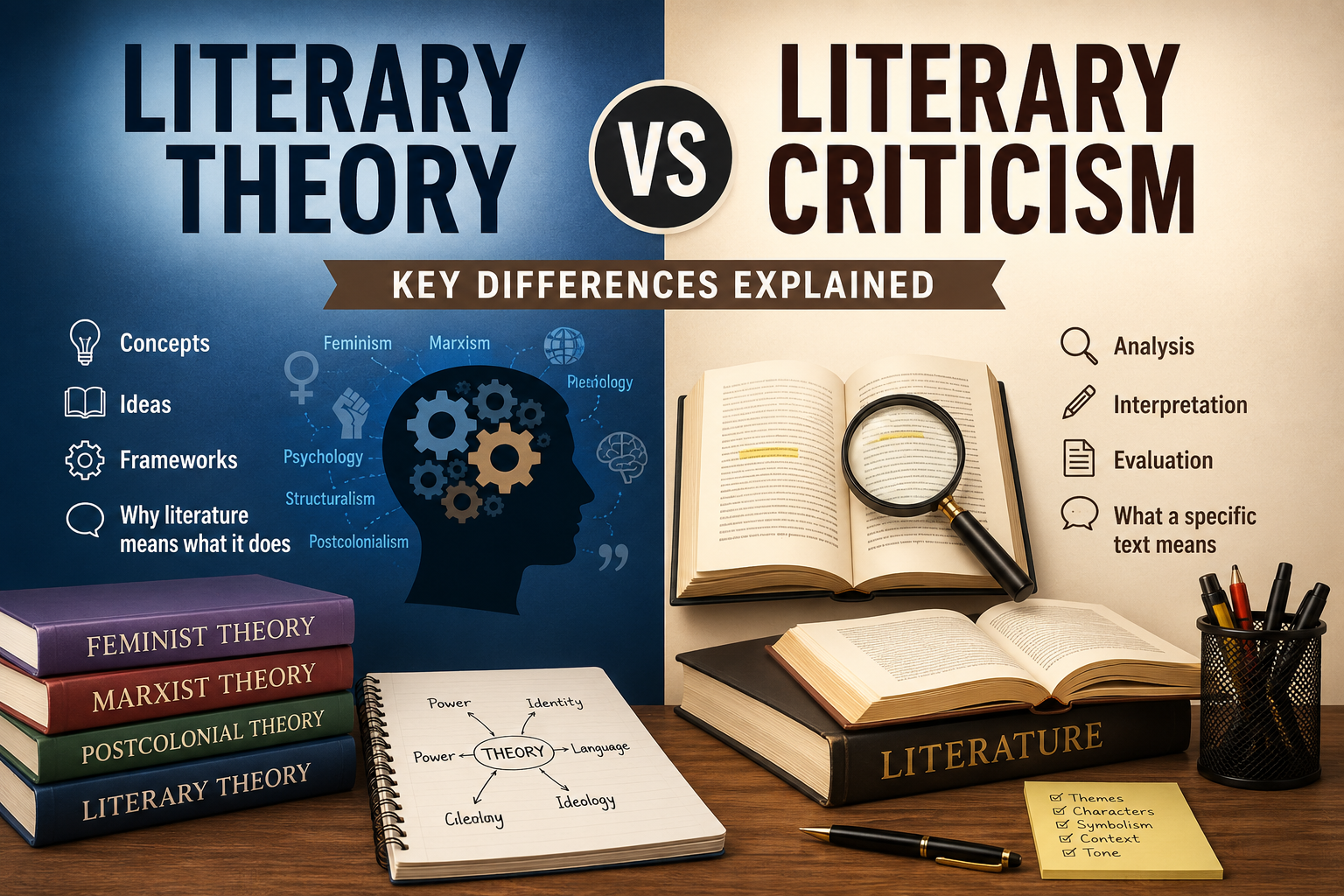
Literature is much more than reading novels, poems, or plays. It involves understanding how texts create meaning, reflect society, and influence readers. Two of the most important concepts in literary studies are literary theory and literary criticism. Although these terms are often used interchangeably, they have distinct meanings and serve different purposes.
If you’re a student, researcher, or literature enthusiast, understanding the difference between literary theory and literary criticism will help you analyze texts more effectively. This guide explains their definitions, major differences, similarities, and practical applications in simple language.
What Is Literary Theory?
Literary theory refers to the set of ideas, principles, and frameworks used to understand and interpret literary works. Rather than focusing on a single text, literary theory explores broader questions about language, culture, society, and meaning.
It provides the conceptual tools that critics use when analyzing literature.
Key Characteristics of Literary Theory
- Focuses on ideas and concepts rather than individual texts.
- Provides frameworks for interpreting literature.
- Examines language, ideology, culture, identity, and power.
- Draws from philosophy, psychology, sociology, history, and linguistics.
- Influences how readers understand literary works.
Common Types of Literary Theory
- Feminist Theory
- Marxist Theory
- Psychoanalytic Theory
- Structuralism
- Poststructuralism
- Reader-Response Theory
- Postcolonial Theory
- Ecocriticism
- Queer Theory
- New Historicism
Each theoretical approach offers a unique perspective for examining literary texts.
What Is Literary Criticism?
Literary criticism is the practice of analyzing, interpreting, evaluating, and discussing specific literary works. Critics use various theories and methods to explain the meaning, structure, themes, and artistic value of a text.
Unlike literary theory, criticism focuses on applying ideas to actual literary works.
Key Characteristics of Literary Criticism
- Analyzes specific literary texts.
- Evaluates themes, style, symbolism, and structure.
- Applies theoretical approaches when appropriate.
- Explains how literature creates meaning.
- Helps readers gain a deeper understanding of texts.
Literary Theory vs. Literary Criticism: Key Differences
The easiest way to understand the distinction is to think of theory as the toolbox and criticism as using those tools.
| Aspect | Literary Theory | Literary Criticism |
|---|---|---|
| Definition | Framework for understanding literature | Analysis and evaluation of literary works |
| Focus | Concepts and ideas | Individual texts |
| Purpose | Develop methods of interpretation | Apply methods to interpret literature |
| Scope | Broad and abstract | Specific and practical |
| Nature | Philosophical and theoretical | Analytical and interpretative |
| Questions Asked | How does literature create meaning? | What does this text mean? |
| Outcome | New perspectives and approaches | Critical interpretation of a work |
Major Differences Between Literary Theory and Literary Criticism
1. Purpose
Literary Theory
- Develops frameworks for understanding literature.
- Explores how meaning is created.
- Questions assumptions about language and culture.
Literary Criticism
- Interprets individual literary texts.
- Evaluates artistic quality.
- Explains themes and symbolism.
2. Scope
Literary theory deals with broad intellectual ideas.
Literary criticism concentrates on specific works such as novels, poems, dramas, or short stories.
3. Approach
Theory asks questions like:
- What is literature?
- How do readers create meaning?
- How does language shape reality?
Criticism asks questions like:
- What themes appear in this novel?
- Why is the protagonist important?
- How does symbolism contribute to the story?
4. Nature
Literary theory is generally abstract and conceptual.
Literary criticism is practical because it applies theories to real texts.
5. Outcome
Theory produces new methods of interpretation.
Criticism produces detailed analyses of literary works.
Similarities Between Literary Theory and Literary Criticism
Although different, both are closely connected.
Both:
- Study literature deeply.
- Seek to understand meaning.
- Encourage critical thinking.
- Improve interpretation skills.
- Examine language and culture.
- Influence literary scholarship.
- Help readers appreciate literature more fully.
How Literary Theory and Literary Criticism Work Together
Theory and criticism are not competitors—they complement one another.
For example:
Suppose a critic analyzes Mary Shelley’s Frankenstein.
- A feminist theory may examine the absence of female authority.
- A Marxist theory may explore class struggles.
- A psychoanalytic theory may interpret Victor Frankenstein’s unconscious desires.
The criticism is the final analysis, while the theory provides the analytical lens.
Examples of Literary Theory in Practice
Here are a few examples of how theoretical perspectives guide literary analysis.
Feminist Theory
Focuses on:
- Gender roles
- Women’s representation
- Patriarchal structures
- Equality
Marxist Theory
Examines:
- Economic inequality
- Social class
- Capitalism
- Power relationships
Psychoanalytic Theory
Explores:
- Dreams
- Desire
- The unconscious mind
- Human motivation
Reader-Response Theory
Emphasizes:
- Reader interpretation
- Personal experience
- Emotional response
- Multiple meanings
Why Understanding the Difference Matters
Knowing the distinction between literary theory and literary criticism offers several benefits.
It Helps Students
- Write stronger essays.
- Develop analytical skills.
- Understand academic discussions.
It Helps Researchers
- Choose appropriate research methods.
- Apply relevant theoretical frameworks.
- Produce more insightful interpretations.
It Helps Readers
- Appreciate literature more deeply.
- Recognize multiple perspectives.
- Engage critically with texts.
Common Misconceptions
Many people confuse these two concepts.
Myth 1: They Are the Same
Reality: Theory provides ideas, while criticism applies them.
Myth 2: Literary Theory Is Only for Scholars
Reality: Anyone interested in literature can use theoretical perspectives to enrich their reading.
Myth 3: Literary Criticism Is Only About Finding Faults
Reality: Literary criticism is not merely judgment; it involves careful interpretation, explanation, and evaluation.
Tips for Studying Literary Theory and Literary Criticism
To build a stronger understanding:
- Learn the major schools of literary theory.
- Practice analyzing different genres.
- Compare multiple interpretations of the same text.
- Read classic and contemporary criticism.
- Ask critical questions while reading.
- Connect literary works with historical and cultural contexts.
- Keep notes on recurring themes and symbols.
Frequently Asked Questions
Is literary theory the same as literary criticism?
No. Literary theory develops interpretive frameworks, while literary criticism applies those frameworks to analyze literary texts.
Which comes first, theory or criticism?
Generally, literary theory provides the concepts that guide literary criticism.
Can literary criticism exist without theory?
Yes, but most modern criticism uses at least one theoretical perspective, even if implicitly.
Why is literary theory important?
It helps readers understand how literature reflects culture, identity, language, politics, and human experience.
What is the main goal of literary criticism?
The primary goal is to interpret, analyze, and evaluate literary works in meaningful ways.
Can one text be analyzed using multiple theories?
Absolutely. A single literary work can be interpreted through feminist, Marxist, psychoanalytic, postcolonial, and other theoretical lenses, each revealing different insights.
Conclusion
Understanding literary theory vs. literary criticism is essential for anyone studying literature. Literary theory offers the intellectual frameworks that explain how texts generate meaning, while literary criticism applies those frameworks to interpret and evaluate individual works. Together, they deepen our appreciation of literature by revealing its artistic, cultural, historical, and social significance.
Whether you’re preparing for exams, writing academic papers, or simply exploring literature for personal enrichment, mastering both concepts will strengthen your analytical skills and broaden your perspective. Instead of viewing them as separate disciplines, think of literary theory as the foundation and literary criticism as the practical application that brings literary analysis to life.