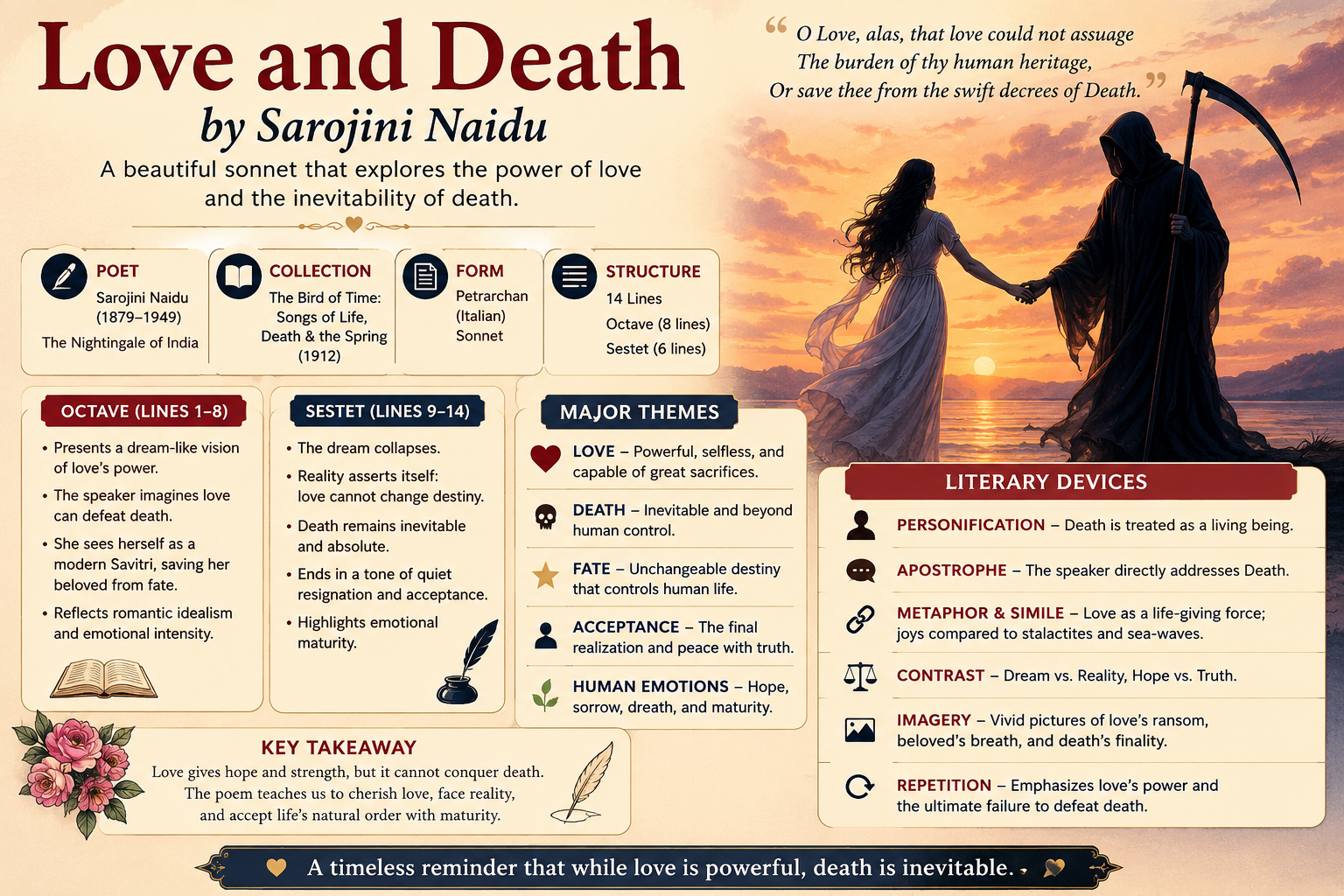
Sarojini Naidu, popularly known as the “Nightingale of India,” was one of India’s greatest poets. Her poetry is admired for its lyrical beauty, emotional depth, and philosophical ideas. One of her remarkable sonnets, Love and Death, explores the timeless conflict between the strongest human emotion—love—and the unavoidable reality of death.
This poem first appeared in The Bird of Time: Songs of Life, Death & the Spring, her second collection of poems. It presents the hopeful dream that love can conquer death before accepting the painful truth that death is inevitable. The poem follows the structure of a Petrarchan (Italian) sonnet, making it an excellent example of both literary craftsmanship and emotional expression.
Quick Facts About the Poem
| Feature | Details |
|---|---|
| Poem | Love and Death |
| Poet | Sarojini Naidu |
| Collection | The Bird of Time |
| Publication | 1912 |
| Form | Petrarchan (Italian) Sonnet |
| Theme | Love, Death, Fate, Acceptance |
| Tone | Romantic, Emotional, Philosophical |
About Sarojini Naidu
Sarojini Naidu (1879–1949) was:
- Known as the Nightingale of India
- A famous Indian poet
- Freedom fighter
- Political leader
- Inspirational speaker
- Writer of lyrical poetry
Her poems mainly focus on:
- Nature
- Love
- Patriotism
- Indian culture
- Human emotions
- Life and Death
These details about her literary background and major works are outlined in the opening pages of the PDF.
Summary of Love and Death
The poem begins with the speaker describing a beautiful dream. She imagines that her powerful love has defeated death itself. In her dream, she believes that love has rescued her beloved from fate and granted him immortality. She compares herself to Savitri, the legendary woman from Indian mythology who saved her husband Satyavan from the God of Death.
However, this joyful dream soon ends.
When the speaker wakes up, she realizes the painful truth. Love cannot stop death. It cannot change destiny or extend a person’s life, even by a single heartbeat. She accepts that every human being must eventually face death.
The poem therefore moves from hope to reality, teaching readers that although love is one of life’s greatest powers, it cannot overcome the universal law of death. This progression from dream to acceptance is explained in the PDF’s discussion of the octave and sestet.
Structure of the Poem
The poem is written as a Petrarchan Sonnet.
It contains:
- 14 lines
- Octave (First 8 lines)
- Sestet (Last 6 lines)
Octave (Lines 1–8)
The first part presents a dream.
The speaker imagines:
- Love defeats death.
- Fate loses its power.
- Her beloved becomes immortal.
- Love becomes stronger than death.
- She becomes another Savitri.
The mood is:
- Hopeful
- Romantic
- Idealistic
- Emotional
Sestet (Lines 9–14)
The second part reveals reality.
The speaker realizes:
- Dreams cannot change destiny.
- Love cannot stop suffering.
- Death is unavoidable.
- Human beings must accept fate.
The mood changes to:
- Calm
- Mature
- Reflective
- Accepting
This clear contrast between the two sections is one of the poem’s central artistic features.
Major Themes
1. Love
Love appears as the strongest emotional force.
It gives:
- Hope
- Comfort
- Strength
- Faith
Initially, the speaker believes love can conquer everything.
2. Death
Death represents:
- Reality
- Fate
- Human limitation
- Finality
The poem reminds readers that no human power can defeat death.
3. Fate
Another important idea is destiny.
The poem teaches:
- Fate cannot be changed.
- Every life has an end.
- Human beings cannot escape destiny.
4. Acceptance
The ending encourages emotional maturity.
Instead of fighting reality forever, the speaker accepts life’s natural order.
5. Human Emotions
The poem beautifully captures:
- Hope
- Fear
- Love
- Loss
- Sorrow
- Acceptance
Literary Devices
Sarojini Naidu uses several literary techniques to make the poem emotionally powerful.
Personification
Death is presented like a living being with power over human life.
Effect:
- Makes death appear real and dramatic.
Apostrophe
The speaker directly addresses Death.
Effect:
- Creates emotional intensity.
- Makes the poem feel like a heartfelt conversation.
Metaphor
Love becomes a symbol of:
- Protection
- Hope
- Immortality
Allusion
The poem refers to Savitri, the mythological heroine who rescued her husband from death.
Importance:
- Symbolizes courage.
- Represents faithful love.
- Connects Indian mythology with universal emotions.
Imagery
The poet creates vivid pictures through expressions such as:
- Love’s ransom
- Beloved’s breath
- Death’s cold power
These images make abstract ideas easier to imagine.
Contrast (Juxtaposition)
The greatest contrast appears between:
Dream
vs.
Reality
This shift makes the ending more emotional and memorable.
Repetition
The repeated use of words related to love and death emphasizes the central conflict of the poem.
Important Symbols
| Symbol | Meaning |
|---|---|
| Love | Hope and emotional strength |
| Death | Inevitable reality |
| Dream | Human desire and imagination |
| Awakening | Acceptance of truth |
| Savitri | Faithful and courageous love |
Message of the Poem
Sarojini Naidu teaches readers that:
- Love is powerful.
- Dreams inspire hope.
- Reality cannot always match our wishes.
- Death is a universal truth.
- Acceptance brings peace.
The poem encourages readers to appreciate love while recognizing the natural cycle of life and death.
Exam-Oriented Points
Why is the poem important?
- Shows emotional maturity.
- Blends Indian mythology with modern poetry.
- Explores universal themes.
- Uses beautiful imagery.
- Demonstrates the structure of a Petrarchan sonnet.
Key Takeaways
- ✔ Love cannot conquer death.
- ✔ Fate cannot be changed.
- ✔ Dreams differ from reality.
- ✔ Acceptance is a sign of wisdom.
- ✔ The poem combines romance with philosophy.
Frequently Asked Questions (FAQs)
1. Who wrote Love and Death?
Sarojini Naidu wrote Love and Death, one of her well-known philosophical sonnets.
2. What is the main theme of the poem?
The poem explores the relationship between love, fate, and the inevitability of death.
3. What type of poem is Love and Death?
It is a Petrarchan (Italian) sonnet consisting of an octave and a sestet.
4. Why is Savitri mentioned in the poem?
Savitri symbolizes devoted love and courage, as she famously rescued her husband from death in Indian mythology.
5. What happens in the poem’s ending?
The speaker realizes that love cannot change destiny or prevent death, leading to quiet acceptance.
6. Why is this poem important for literature students?
It is a valuable study text because it combines lyrical beauty, symbolism, mythology, and philosophical reflection while illustrating the classic sonnet form.
Conclusion
Love and Death by Sarojini Naidu is a timeless poem that balances hope with reality. Through the movement from an idealistic dream to a mature acceptance of fate, the poet reminds readers that while love is one of humanity’s greatest strengths, it cannot overcome the certainty of death. Rich in symbolism, imagery, and emotion, the poem remains an excellent choice for literature students seeking to understand themes of love, destiny, and the human condition. This guide is based on the information presented in your uploaded PDF and expands it into a student-friendly explanation with clear headings and bullet points.