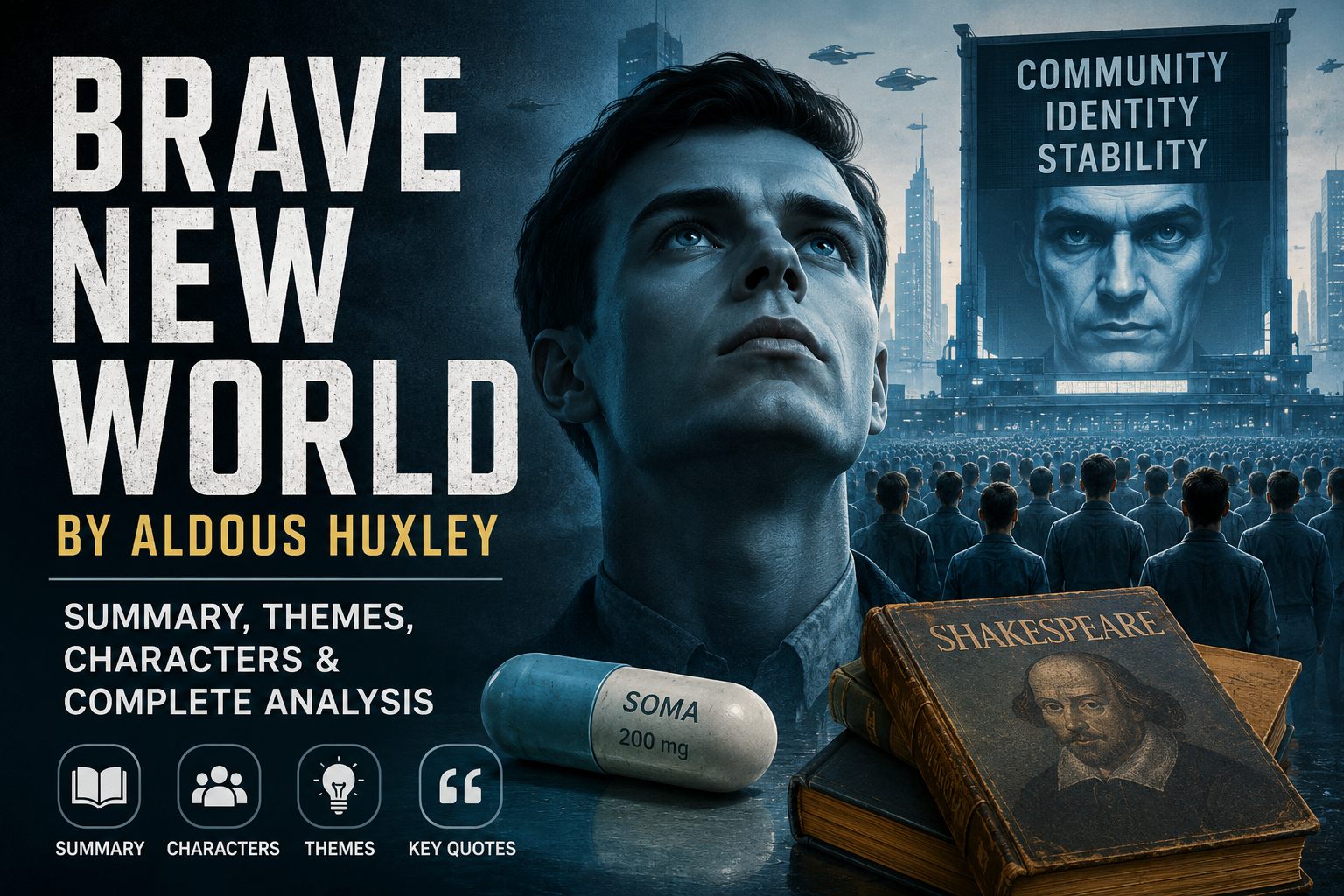
Brave New World by Aldous Huxley is one of the most influential dystopian novels in English literature. Published in 1932, the novel imagines a futuristic society where scientific advancements, psychological conditioning, and consumerism have replaced freedom, family, and individuality. Instead of using fear to control people, the government keeps citizens obedient through pleasure, entertainment, and a happiness-inducing drug called soma.
The novel raises important questions about technology, human freedom, and the true meaning of happiness. Even decades after its publication, Brave New World continues to be studied because many of its ideas remain relevant in today’s technology-driven world.
About the Author
Aldous Huxley was an English novelist, essayist, and philosopher known for his intellectual and thought-provoking works.
Quick Facts
- Full Name: Aldous Leonard Huxley
- Born: 26 July 1894
- Nationality: English
- Profession: Novelist, Essayist, Critic
- Famous Work: Brave New World
- Published: 1932
Huxley explored themes such as science, politics, philosophy, and human nature throughout his writing. His vision of a controlled society has made Brave New World one of the greatest dystopian novels ever written.
Brave New World at a Glance
| Feature | Details |
|---|---|
| Author | Aldous Huxley |
| Genre | Dystopian Fiction |
| Published | 1932 |
| Setting | World State |
| Main Theme | Freedom vs. Control |
| Famous Motto | Community, Identity, Stability |
Brave New World Summary
The story is set in the World State, a futuristic civilization where humans are no longer born naturally. Instead, they are scientifically created in laboratories and assigned to different social classes before birth.
Every individual is conditioned from childhood to love their assigned role and never question authority. Society is divided into five castes:
- Alpha
- Beta
- Gamma
- Delta
- Epsilon
Each caste performs specific duties, ensuring that society functions efficiently without conflict. Citizens are taught that happiness comes from consuming products, avoiding deep emotions, and taking soma, a drug that removes stress and sadness.
The story follows Bernard Marx, an Alpha psychologist who feels different from everyone else. Although he enjoys many privileges, he longs for genuine emotions and meaningful relationships. His unusual thinking makes him an outsider.
During a visit to the Savage Reservation, Bernard meets John, a young man raised outside the World State. Unlike civilized citizens, John believes in love, sacrifice, family, and personal freedom. Inspired by the works of Shakespeare, he values human emotions over artificial happiness.
When Bernard brings John to London, John initially admires the advanced society. However, he soon realizes that the World State has sacrificed freedom, creativity, and individuality in exchange for stability. Unable to accept this artificial way of life, John openly criticizes society and rejects soma.
The conflict between John’s natural humanity and the World State’s controlled lifestyle forms the heart of the novel. The tragic ending reminds readers that happiness without freedom may come at a terrible cost.
Major Characters
Bernard Marx
- Alpha Plus psychologist
- Questions social conditioning
- Feels isolated from society
- Represents individuality and self-doubt
John (The Savage)
- Raised outside civilization
- Loves Shakespeare
- Values love, sacrifice, and morality
- Represents natural human emotions
Lenina Crowne
- Beta worker
- Follows World State rules
- Believes in casual relationships
- Represents social conformity
Mustapha Mond
- One of the World Controllers
- Highly intelligent leader
- Believes stability is more important than freedom
- Defends the principles of the World State
Major Themes
1. Individuality vs. Conformity
One of the novel’s central themes is the struggle between personal identity and social conformity.
The World State eliminates individuality through:
- Genetic engineering
- Sleep-teaching (Hypnopaedia)
- Psychological conditioning
- Strict social roles
Bernard and John challenge these ideas by seeking independent thought and genuine emotions.
2. Technology and Social Control
Technology is not used to improve freedom but to control society.
Examples include:
- Artificial reproduction
- Embryo conditioning
- Scientific caste system
- Hypnopaedia
- Soma
Huxley warns that technology without ethics can threaten human freedom.
3. Happiness vs. Freedom
The novel asks a powerful question:
Is artificial happiness better than real freedom?
The World State offers:
- No poverty
- No war
- No sadness
But citizens lose:
- Individuality
- Creativity
- Love
- Family
- Freedom of choice
4. Consumerism
People are conditioned to buy new products instead of repairing old ones.
Famous slogan:
“Ending is better than mending.”
This reflects a society driven by endless consumption rather than meaningful living.
Important Symbols
Soma
Soma symbolizes:
- Artificial happiness
- Escape from reality
- Government control
The Hatchery
Represents:
- Industrial production of humans
- Scientific manipulation
- Loss of natural birth
The Savage Reservation
Symbolizes:
- Natural life
- Family values
- Religion
- Human emotions
- Freedom despite suffering
Why Is Brave New World Still Relevant?
Although written in 1932, the novel remains highly relevant because it explores issues that continue to shape modern society.
These include:
- Artificial Intelligence
- Genetic Engineering
- Social Media
- Consumer Culture
- Government Surveillance
- Mental Health
- Technology Addiction
- Loss of Privacy
Many readers believe Huxley accurately predicted how technology and entertainment could influence human behavior.
Key Takeaways
- Published in 1932 by Aldous Huxley.
- A classic dystopian novel.
- Explores scientific control over society.
- Questions artificial happiness.
- Highlights the importance of freedom.
- Criticizes excessive consumerism.
- Remains relevant in the modern technological era.
Frequently Asked Questions
Why is Brave New World considered a dystopian novel?
It portrays a futuristic society where freedom, family, and individuality are sacrificed for stability and social control.
Who is the main protagonist?
John the Savage becomes the novel’s central character as he challenges the values of the World State.
What does soma symbolize?
Soma represents artificial happiness, emotional escape, and government control over society.
What is the main theme of the novel?
The novel explores the conflict between freedom and control while questioning whether comfort is worth sacrificing individuality.
Why is the novel still popular today?
Its discussion of technology, consumerism, and social control remains highly relevant in the modern world.
Conclusion
Brave New World is far more than a science fiction novel. It is a timeless warning about the dangers of allowing technology, consumerism, and government control to replace individuality and genuine human relationships. Through memorable characters, powerful symbolism, and thought-provoking themes, Aldous Huxley encourages readers to question what true happiness really means.
Whether you are a student preparing for exams or a literature enthusiast exploring dystopian fiction, Brave New World offers valuable insights into the relationship between freedom, technology, and humanity. Its enduring relevance makes it one of the most important novels in English literature and a must-read for anyone interested in understanding the future of society.