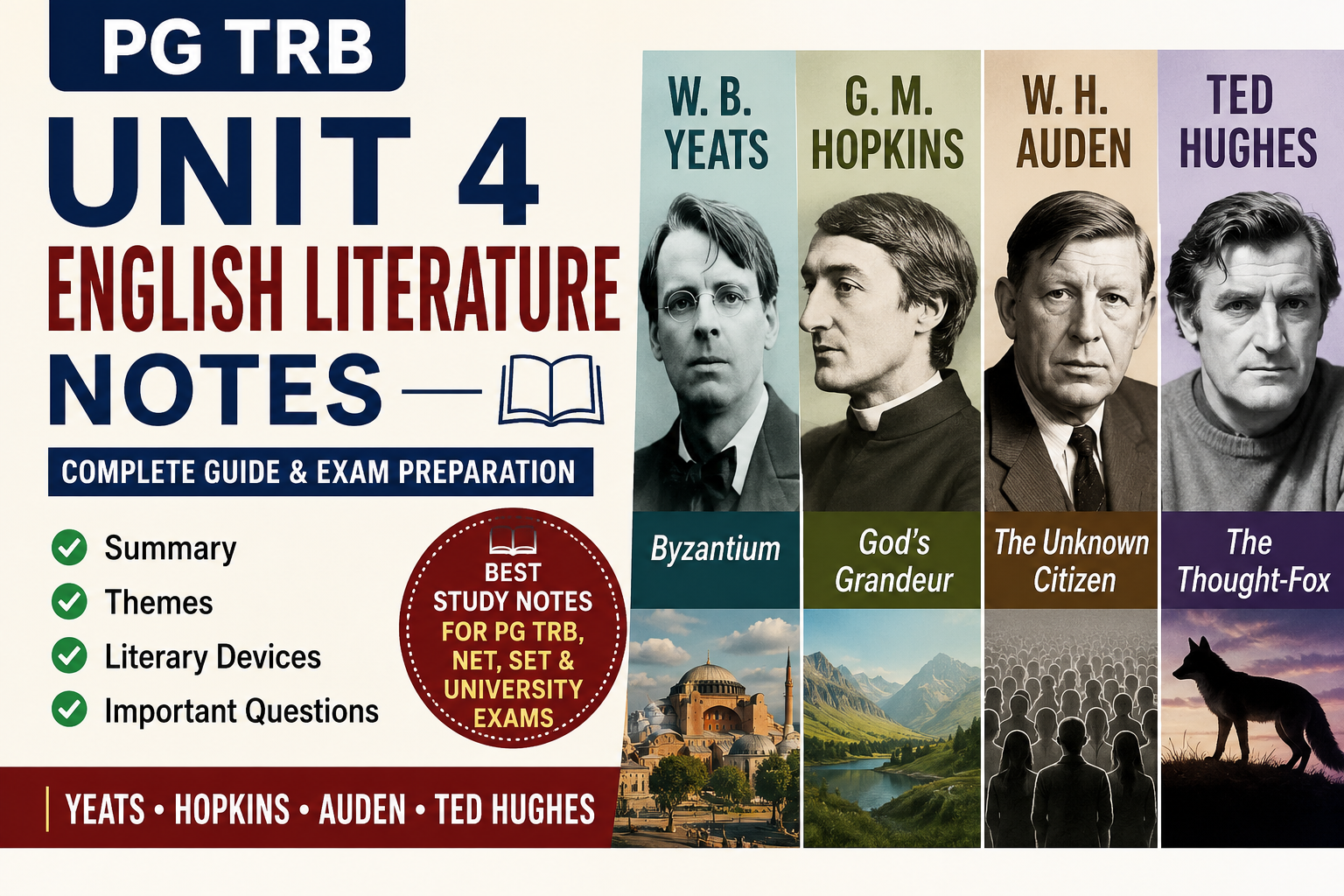
If you are preparing for the PG TRB English examination, Unit 4 is one of the most important sections. It introduces four influential twentieth-century poets whose works are frequently asked in objective and descriptive examinations.
According to the uploaded study material, Unit 4 focuses on four major poems:
- Byzantium by W.B. Yeats
- God’s Grandeur by Gerard Manley Hopkins
- The Unknown Citizen by W.H. Auden
- The Thought-Fox by Ted Hughes
Understanding the biographies, poetic techniques, symbolism, themes, and literary devices of these poets can significantly improve exam performance.
W.B. Yeats
William Butler Yeats (1865–1939) was one of Ireland’s greatest poets and won the Nobel Prize in Literature in 1923. He played a central role in the Irish Literary Revival and co-founded the Abbey Theatre.
The study material highlights Yeats’ major works, including The Second Coming, Sailing to Byzantium, Byzantium, The Tower, and The Wild Swans at Coole.
Major Contributions
- Irish Literary Revival
- Symbolist Poetry
- Modernism
- Celtic Mythology
- Nobel Prize Winner
Byzantium – Summary
Byzantium was written in 1930 and later published in Words for Music Perhaps and Other Poems (1932). It consists of five eight-line stanzas and is classified as a metaphysical poem.
The poem explores the transformation of the human soul from the physical world into the eternal world of art and spirituality. Byzantium symbolizes perfection, immortality, and divine beauty.
Major Themes
- Spiritual purification
- Art versus nature
- Eternal life
- Death and rebirth
- Mysticism
Gerard Manley Hopkins
Gerard Manley Hopkins (1844–1889) was a Jesuit priest known for his innovative poetic style. He introduced Sprung Rhythm, which transformed English poetry.
The document also discusses Hopkins’ concepts of Inscape and Instress, fundamental ideas in understanding his poetry.
God’s Grandeur – Summary
Written in 1877, God’s Grandeur is an Italian (Petrarchan) sonnet with an ABBAABBA CDCDCD rhyme scheme.
The poem celebrates God’s presence throughout nature despite the damage caused by industrialization and human greed.
Important Themes
- God’s glory
- Nature
- Environmental degradation
- Hope
- Faith
W.H. Auden
Wystan Hugh Auden (1907–1973) was one of the greatest twentieth-century poets.
His famous poems include:
- The Unknown Citizen
- Funeral Blues
- September 1, 1939
- Musée des Beaux Arts
The Unknown Citizen – Summary
Published in 1940, this satirical poem criticizes modern bureaucracy, government surveillance, and society’s tendency to measure individuals using statistics rather than humanity.
Major Themes
- Individuality
- Bureaucracy
- Consumerism
- Government control
- Social conformity
Ted Hughes
Ted Hughes (1930–1998) became Poet Laureate in 1984 and is widely known as the “Animal Poet.”
Some of his famous works include:
- The Thought-Fox
- Hawk Roosting
- Crow
- The Iron Man
The Thought-Fox – Summary
Published in The Hawk in the Rain (1957), this metapoem describes the mysterious process of poetic creation through the symbolic image of a fox gradually emerging from darkness until inspiration fills the poet’s mind.
Major Themes
- Creativity
- Imagination
- Nature
- Artistic inspiration
- The writing process
Important PG TRB Exam Questions
- Explain the symbolism in Byzantium.
- Discuss the major themes of God’s Grandeur.
- What is Sprung Rhythm?
- Explain Inscape and Instress.
- Why is The Unknown Citizen considered satirical?
- Discuss irony in Auden’s poetry.
- Explain the symbolism of the fox in The Thought-Fox.
- Write a note on Ted Hughes as an Animal Poet.
Quick Revision Table
| Poet | Poem | Important Concept |
|---|---|---|
| W.B. Yeats | Byzantium | Symbolism, Spirituality |
| G.M. Hopkins | God’s Grandeur | Sprung Rhythm, Inscape |
| W.H. Auden | The Unknown Citizen | Satire, Irony |
| Ted Hughes | The Thought-Fox | Creativity, Nature |
Frequently Asked Questions
Which poems are included in PG TRB Unit 4?
The unit covers Byzantium, God’s Grandeur, The Unknown Citizen, and The Thought-Fox.
Who wrote Byzantium?
William Butler Yeats.
What is Sprung Rhythm?
It is Hopkins’ unique metrical system that emphasizes stressed syllables.
Why is The Unknown Citizen satirical?
It criticizes society for reducing people to statistics and official records.
What does the fox symbolize in The Thought-Fox?
The fox represents poetic inspiration and the creative imagination.
Is this unit important for PG TRB?
Yes. These poets and poems are among the most frequently tested topics in PG TRB English examinations.
Conclusion
PG TRB Unit 4 introduces four iconic modern poets whose works explore spirituality, nature, bureaucracy, creativity, and human existence. A strong understanding of these poems, along with their themes, literary devices, symbolism, and historical context, provides a solid foundation for success in PG TRB, UGC NET, SET, and university examinations.