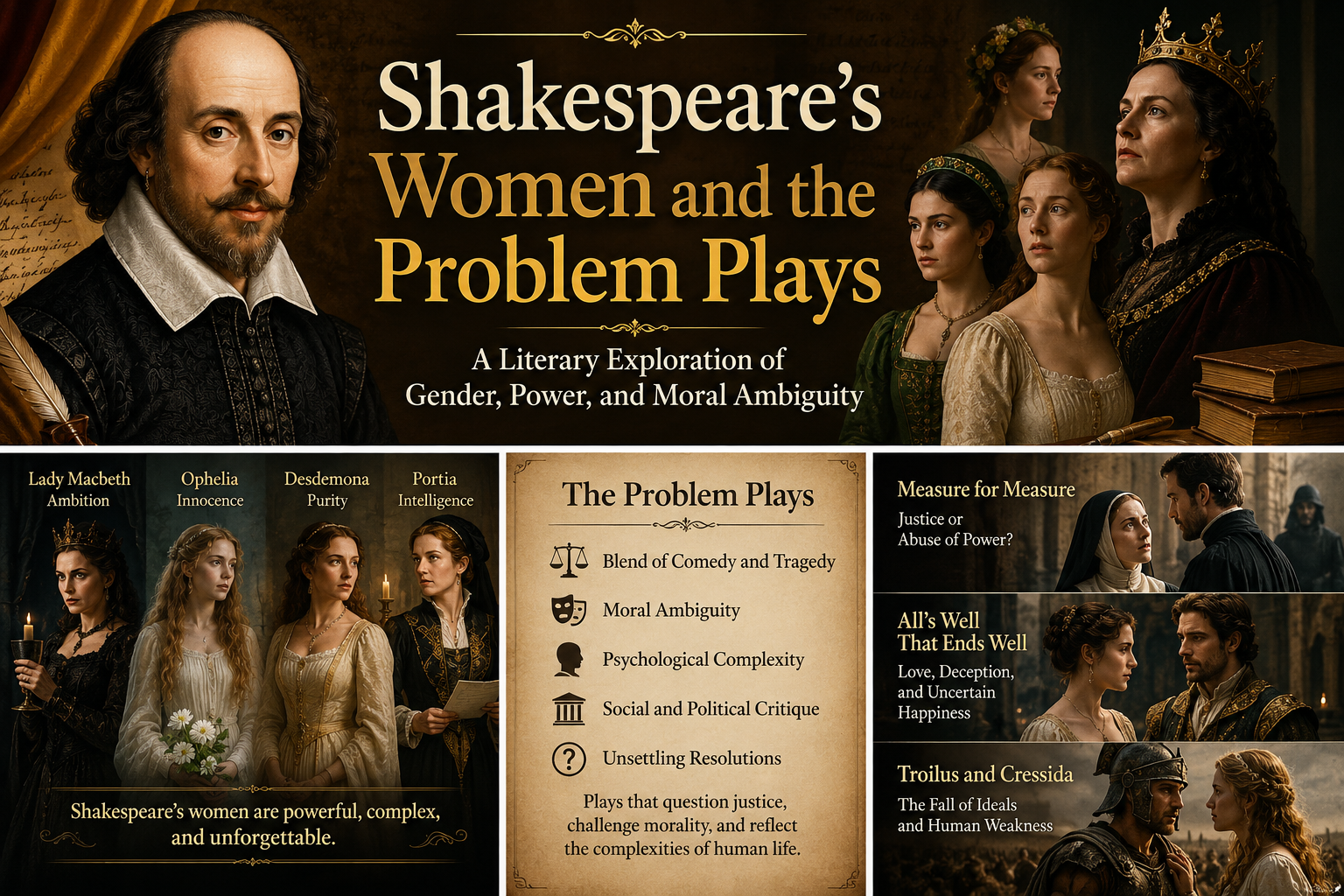
Few writers in world literature have portrayed women as memorably as William Shakespeare. While the Elizabethan era often restricted women’s social roles, Shakespeare created heroines who displayed intelligence, courage, wit, and emotional resilience. From the ambitious Lady Macbeth to the loyal Desdemona and the clever Portia, his female characters challenge traditional gender expectations.
The study material, “Shakespeare Women & Problem Plays,” highlights how Shakespeare’s heroines contribute significantly to the themes of power, love, morality, and identity. This article explores these women while examining why Shakespeare remains relevant in modern discussions of feminism and literature.
Who Was Shakespeare?
Shakespeare (1564–1616) is widely regarded as the greatest playwright in English literature. His literary contributions include:
- Around 39 plays
- 154 sonnets
- Narrative poems
His works are generally classified into:
| Genre | Famous Works |
|---|---|
| Tragedies | Hamlet, Macbeth, Othello, King Lear |
| Comedies | Twelfth Night, As You Like It, Much Ado About Nothing |
| Romances | The Tempest, Cymbeline |
His plays explore universal themes such as:
- Love
- Ambition
- Betrayal
- Justice
- Gender roles
- Human psychology
Shakespeare’s Portrayal of Women
One of Shakespeare’s greatest achievements is his realistic and multifaceted portrayal of women.
Key Characteristics
His female characters are often:
- Intelligent
- Independent
- Courageous
- Emotionally complex
- Loyal
- Resourceful
Unlike many writers of his time, Shakespeare gave women active roles in shaping the plot rather than merely supporting male protagonists.
Shakespeare and Feminism
Modern scholars often view Shakespeare through a feminist lens.
Why?
His heroines:
- Challenge patriarchal authority.
- Make independent decisions.
- Influence political and personal events.
- Resist social expectations.
The lecture notes suggest that Shakespeare was sympathetic toward women’s struggles and often portrayed them as intellectually equal—or even superior—to men.
Critical Opinions on Shakespeare’s Women
Allardyce Nicoll
Nicoll admired Shakespeare’s ability to create lifelike characters, suggesting the playwright transcended his creations while remaining deeply connected to them.
Compton Rickett
Rickett famously observed:
“Shakespeare’s women have the primal qualities of womanhood common to every age.”
He believed Shakespeare understood female psychology remarkably well.
Major Female Characters in Shakespeare
1. Lady Macbeth: The Face of Ambition
Lady Macbeth is one of literature’s most controversial women.
Traits
- Ambitious
- Manipulative
- Fearless
- Dominant
She persuades Macbeth to murder King Duncan, famously advising:
“Look like the innocent flower, but be the serpent under’t.”
Significance
Lady Macbeth challenges conventional ideas of femininity by embracing power and political influence. However, guilt eventually destroys her, showing the tragic consequences of unchecked ambition.
2. Ophelia: The Victim of Patriarchy
Ophelia symbolizes innocence and vulnerability.
Characteristics
- Gentle
- Obedient
- Sensitive
She is manipulated by:
- Polonius
- Laertes
- Hamlet
Unable to express her true feelings, she descends into madness.
Literary Importance
Ophelia represents the emotional cost of patriarchal control.
3. Desdemona: Innocence Destroyed
Desdemona is a symbol of loyalty and purity.
Her Role
- Marries for love.
- Remains faithful to Othello.
- Becomes the victim of jealousy and deception.
Her tragic fate highlights the destructive power of suspicion and insecurity.
4. Miranda: Nature’s Purest Heroine
Miranda embodies innocence and compassion.
She is:
- Kind-hearted
- Honest
- Loving
Her famous declaration to Ferdinand,
“I am your wife, if you will marry me,”
reveals her sincerity and emotional courage.
5. Viola: Intelligence and Sacrifice
Viola disguises herself as Cesario.
Symbolizes
- Patience
- Loyalty
- Emotional strength
Critics have praised her as both the emotional and dramatic center of the play.
6. Rosalind: Shakespeare’s Wittiest Heroine
Rosalind is celebrated for her wit and intelligence.
She:
- Disguises herself as Ganymede.
- Tests Orlando’s love.
- Controls much of the play’s action.
Her character combines humor with emotional depth.
7. Portia: The Genius of Justice
Portia demonstrates extraordinary intelligence.
Greatest Achievement
Disguised as a lawyer, she defeats Shylock through legal reasoning and saves Antonio.
Portia represents:
- Wisdom
- Courage
- Practical intelligence
8. Cordelia: Truth and Integrity
Cordelia refuses to flatter her father for personal gain.
Represents
- Honesty
- Loyalty
- Moral courage
Her tragic death reinforces the play’s exploration of justice and sacrifice.
Women in Shakespeare’s Comedies
Unlike tragic heroines, women in Shakespeare’s comedies often shape their destinies.
Common Features
- Cross-dressing
- Mistaken identity
- Romantic independence
- Verbal wit
Examples
| Character | Strength |
|---|---|
| Viola | Patience |
| Rosalind | Intelligence |
| Beatrice | Wit |
| Hermia | Determination |
| Portia | Justice |
Understanding Shakespeare’s Problem Plays
Problem plays combine elements of comedy and tragedy while addressing moral and social dilemmas.
Common Themes
- Justice
- Gender inequality
- Sexual politics
- Power
- Mercy
- Social hypocrisy
These plays resist easy classification, making them intellectually engaging and relevant today.
Major Themes in Shakespeare’s Women
Gender Roles
Women challenge traditional expectations.
Love
Love is portrayed as both empowering and destructive.
Power
Female characters often influence political and family decisions.
Identity
Disguises allow women to explore freedom and independence.
Morality
Characters like Cordelia and Desdemona represent ethical integrity.
Why Shakespeare’s Women Matter Today
Modern readers continue to connect with Shakespeare’s heroines because they address contemporary issues:
- Gender equality
- Female leadership
- Emotional resilience
- Personal identity
- Social justice
Their struggles remain relevant across cultures and generations.
Key Takeaways
✔ Shakespeare created some of literature’s strongest female characters.
✔ His women challenge patriarchal structures.
✔ Tragic heroines reveal the consequences of social oppression.
✔ Comic heroines demonstrate intelligence and independence.
✔ Problem plays explore complex moral and social issues.
✔ Shakespeare’s portrayal of women contributes to ongoing feminist discussions.
Frequently Asked Questions (FAQs)
1. Why are Shakespeare’s women considered revolutionary?
Because they display intelligence, independence, and emotional complexity beyond the expectations of their era.
2. Who is Shakespeare’s strongest female character?
Many critics consider Lady Macbeth, Portia, and Rosalind among his strongest heroines.
3. What does Ophelia symbolize?
She symbolizes innocence destroyed by patriarchal and political pressures.
4. Why does Viola disguise herself?
To survive and gain opportunities unavailable to women.
5. What makes Portia unique?
Her legal intelligence and courage allow her to save Antonio through wit rather than force.
6. What are Shakespeare’s problem plays?
They are plays that blend comedy and tragedy while exploring difficult moral and social questions.
Conclusion
Shakespeare’s female characters remain among the most compelling creations in world literature. Through women like Lady Macbeth, Portia, Rosalind, Viola, Desdemona, Ophelia, Miranda, and Cordelia, Shakespeare explored ambition, love, justice, sacrifice, and identity with extraordinary psychological depth. The study of Shakespeare’s Women and Problem Plays demonstrates that his heroines were not passive figures but active participants in shaping their destinies and influencing the world around them.
For students of literature, these characters provide valuable insights into Renaissance society while continuing to inspire modern discussions about gender, power, and human nature.
Further reading: Folger Shakespeare Library for scholarly resources on Shakespeare’s works and characters.