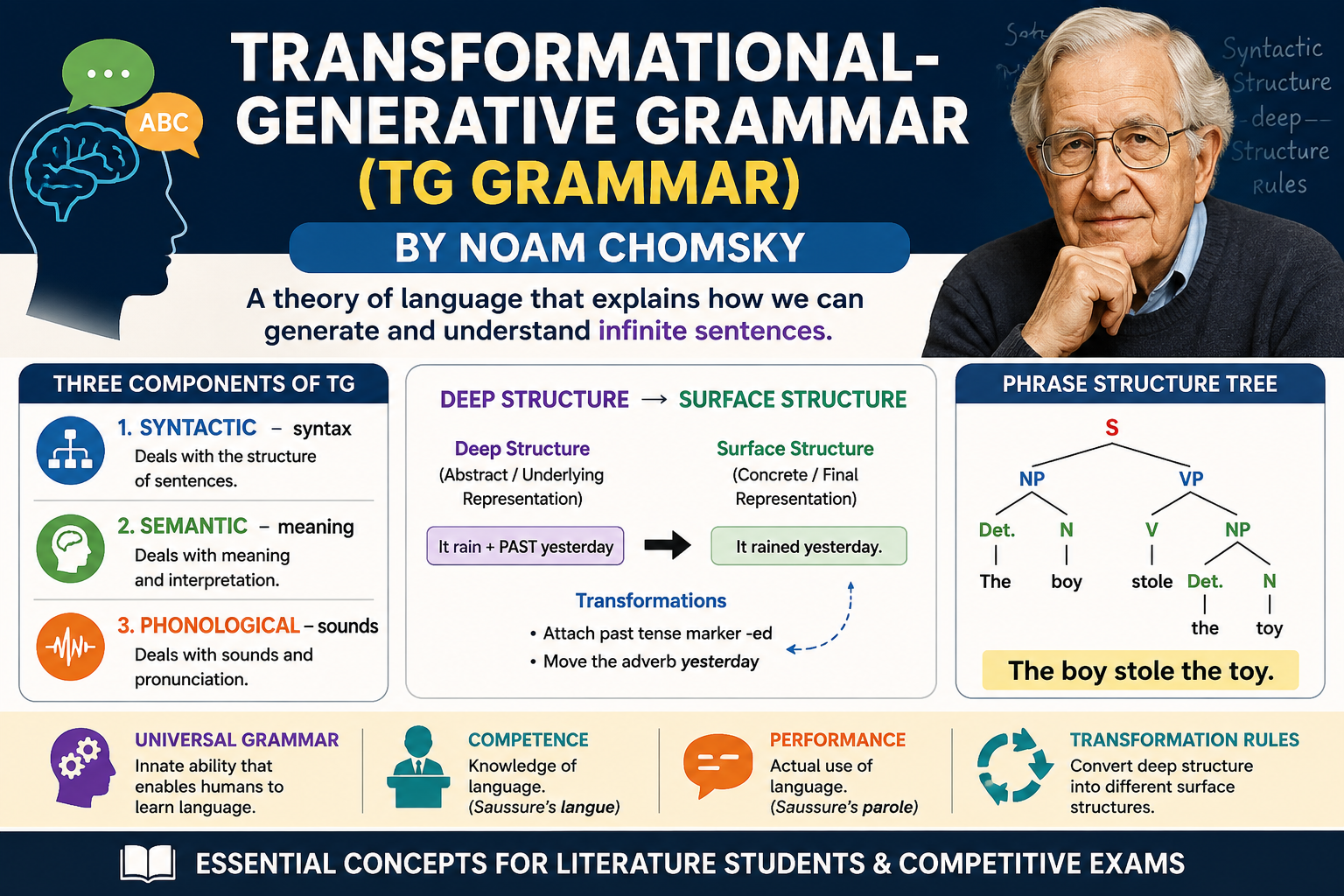
Transformational-Generative Grammar (TG Grammar) is one of the most influential theories in modern linguistics. Developed by Noam Chomsky, this theory revolutionized the study of language by explaining how human beings can produce and understand an unlimited number of sentences using a limited set of grammatical rules. It is an essential topic for English Literature students, Linguistics learners, NET, SET, TRB, and competitive examinations. The uploaded study material covers the core concepts of Universal Grammar, Phrase Structure Rules, Deep Structure, Surface Structure, Transformational Rules, and the components of TG Grammar.
What is Transformational-Generative Grammar?
Transformational-Generative Grammar (TG Grammar) is a linguistic theory introduced by Noam Chomsky.
Definition
Transformational-Generative Grammar is a system of rules capable of generating all grammatically correct sentences of a language by using phrase structure rules and transformational rules.
Main Objectives
- Explain how language is generated.
- Describe the internal structure of sentences.
- Distinguish between grammatical competence and language performance.
- Show the relationship between deep structure and surface structure.
Universal Grammar
One of Chomsky’s greatest contributions is the concept of Universal Grammar.
Meaning
Universal Grammar suggests that every human being is born with an innate ability to learn language.
Key Features
- Language ability is inborn.
- Humans possess internalized grammatical rules.
- These rules allow speakers to produce infinite sentences.
- Every language follows universal principles.
Example
Children learn language naturally without formal grammar instruction.
According to the study material, Universal Grammar refers to the internalized rules that specify the sequences permitted in a language.
Competence vs Performance
Introduced in 1965, Chomsky distinguished between two important concepts.
Competence
Competence refers to the speaker’s knowledge of grammar.
Characteristics
- Mental knowledge
- Ideal grammar
- Internal ability
- Similar to Saussure’s Langue
Performance
Performance refers to the actual use of language in daily communication.
Characteristics
- Speaking
- Writing
- Listening
- Reading
- Similar to Saussure’s Parole
Example
Competence:
Knowing the grammar of English.
Performance:
Speaking English fluently.
The distinction between competence and performance is highlighted in the notes alongside Saussure’s concepts of langue and parole.
Phrase Structure Rules (PS Rules)
Phrase Structure Rules form the basic framework of sentence construction.
Standard Rules
- Sentence → NP + VP
- NP → Determiner + Noun
- VP → Verb + NP
- Verb → stole
- Determiner → the
- Noun → boy, toy
Example
Sentence:
The boy stole the toy.
Structure
- Sentence
- Noun Phrase
- The
- Boy
- Verb Phrase
- Stole
- The toy
- Noun Phrase
The uploaded notes illustrate these phrase structure rules using the sentence The boy stole the toy.
Phrase Structure Grammar (PSG)
Phrase Structure Grammar consists only of phrase structure rules.
Features
- No transformational rules
- Generates grammatical sentences
- Provides constituent analysis
- Explains sentence structure
Advantages
- Easy sentence analysis
- Logical organization
- Foundation of TG Grammar
Deep Structure
Deep Structure represents the original meaning of a sentence.
Characteristics
- Abstract representation
- Shows semantic meaning
- Exists before transformations
Example
Deep Structure
It rain + PAST yesterday
The study material defines deep structure as the underlying abstract syntactic representation before transformations occur.
Surface Structure
Surface Structure is the final spoken or written sentence.
Characteristics
- Concrete form
- Produced after transformations
- Represents actual speech
Example
Surface Structure
It rained yesterday.
Transformation Rules
Transformation Rules convert deep structure into surface structure.
Functions
- Add tense markers
- Move words
- Change active to passive
- Rearrange sentence structure
Example
Deep Structure
It rain + PAST yesterday
↓
Transformation
- Add -ed
- Move “yesterday”
↓
Surface Structure
Yesterday it rained.
The notes explain that transformations include adding tense markers and moving sentence elements to derive the surface form.
Active and Passive Transformation
Active Sentence
He drove a car.
Passive Sentence
A car was driven by him.
Transformation involves:
- Movement
- Insertion
- Auxiliary verbs
- Passive construction
Components of TG Grammar
Transformational-Generative Grammar has three major components.
1. Syntactic Component
Deals with:
- Grammar
- Sentence structure
- Word order
2. Semantic Component
Deals with:
- Meaning
- Interpretation
- Context
3. Phonological Component
Deals with:
- Sounds
- Pronunciation
- Speech
The three-component model—syntactic, semantic, and phonological—is summarized in the uploaded presentation.
Generative Grammar
Generative Grammar enables speakers to produce an unlimited number of grammatical sentences.
Characteristics
- Rule-based
- Infinite sentence production
- Creativity in language
- Mental grammar
Importance of TG Grammar
TG Grammar transformed modern linguistics.
Benefits
- Explains sentence formation
- Connects grammar and meaning
- Influenced language teaching
- Improved linguistic analysis
- Foundation for modern syntax
Advantages
- Scientific study of language
- Explains creativity in language
- Distinguishes competence and performance
- Universal application
- Logical grammatical framework
Limitations
- Highly theoretical
- Complex terminology
- Less emphasis on social context
- Difficult for beginners
- Ignores some communicative aspects
Exam Tips for Literature Students
Remember These Points
- Father of TG Grammar: Noam Chomsky
- Year: 1957 (Syntactic Structures)
- Competence: Knowledge of language
- Performance: Use of language
- Deep Structure: Abstract meaning
- Surface Structure: Spoken sentence
- Phrase Structure Rules: Build sentence structure
- Transformation Rules: Convert deep to surface structure
- Three Components: Syntax, Semantics, Phonology
Frequently Asked Questions (FAQs)
1. Who introduced Transformational-Generative Grammar?
Noam Chomsky introduced Transformational-Generative Grammar.
2. What is Universal Grammar?
Universal Grammar is the innate language ability that enables humans to learn any language.
3. What is the difference between competence and performance?
Competence is knowledge of language, while performance is the actual use of language.
4. What are Phrase Structure Rules?
They are grammatical rules used to construct sentence structures.
5. What is Deep Structure?
Deep Structure is the underlying abstract representation of a sentence before transformations.
6. What are the three components of TG Grammar?
The three components are:
Syntactic Component
Semantic Component
Phonological Component
Conclusion
Transformational-Generative Grammar remains one of the most significant linguistic theories in modern language studies. By introducing concepts such as Universal Grammar, Competence and Performance, Phrase Structure Rules, Deep Structure, Surface Structure, and Transformational Rules, Noam Chomsky fundamentally changed the way linguists understand language. For literature students and aspirants preparing for competitive examinations such as UGC NET, SET, TRB, and PG Entrance Exams, mastering these concepts provides a strong foundation in modern linguistics and syntax. The uploaded lecture notes serve as an excellent guide for revising these core principles.