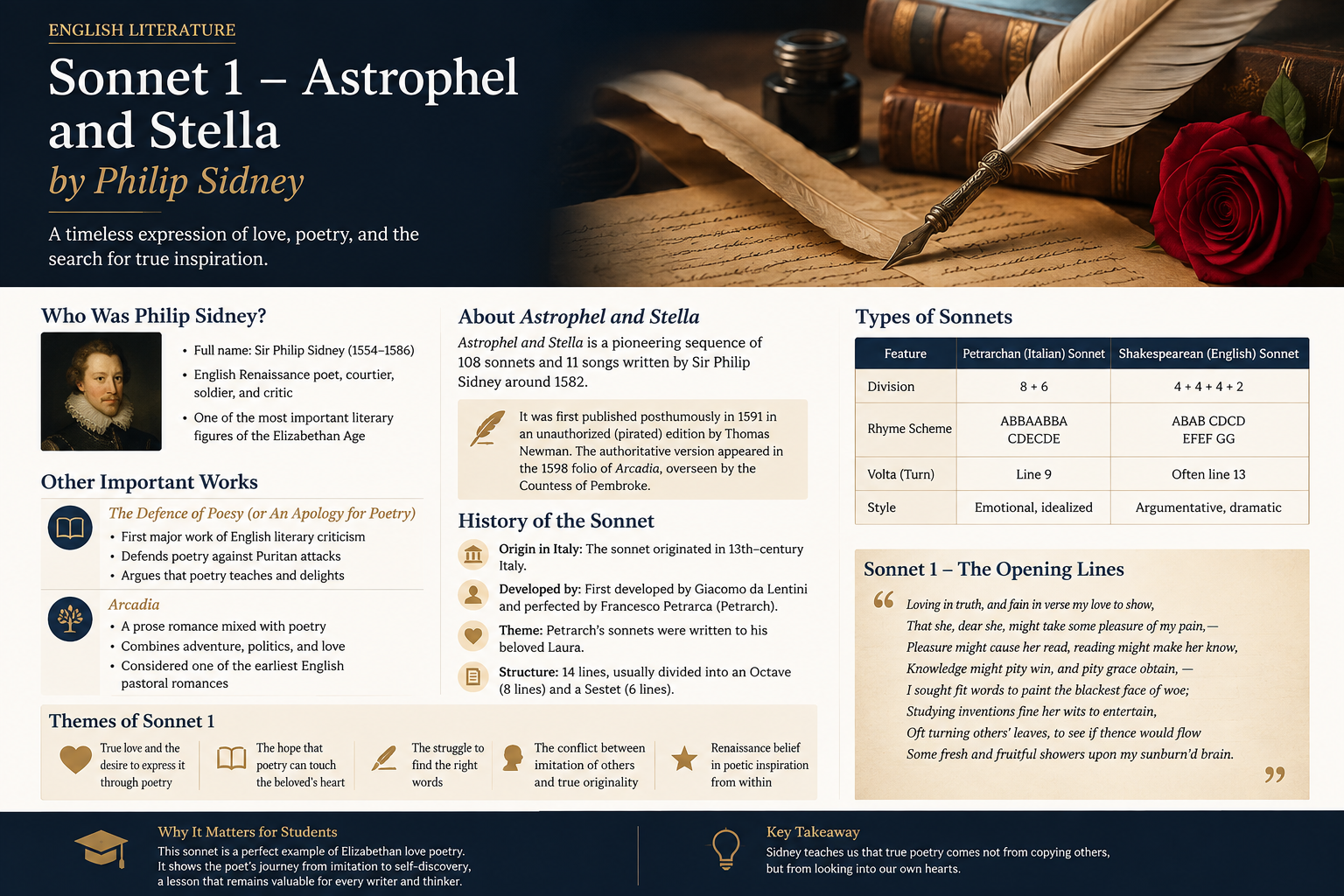
Learn about Astrophel and Stella Sonnet 1 by Sir Philip Sidney with this student-friendly guide covering summary, themes, literary analysis, sonnet history, and key takeaways.
Astrophel and Stella Sonnet 1 Explained: A Complete Student Guide
Introduction
Among the masterpieces of English Renaissance literature, Sir Philip Sidney’s Astrophel and Stella occupies a special place. The sonnet sequence is admired for its emotional sincerity, literary craftsmanship, and exploration of poetic inspiration. The opening poem, Sonnet 1, introduces readers to a poet struggling to express genuine love through verse.
For literature students, this sonnet is more than a romantic poem—it offers valuable lessons about creativity, originality, and the art of writing. This guide explains the poet, the sonnet’s background, major themes, literary significance, and why it remains relevant today.
Who Was Sir Philip Sidney?
Sir Philip Sidney (1554–1586) was one of the leading literary figures of the Elizabethan Age. According to the uploaded course material, he was an English Renaissance poet, courtier, soldier, and critic whose influence extended beyond poetry into literary criticism.
Sidney believed literature should educate while also entertaining readers, a philosophy reflected throughout his works.
His contribution to English literature helped establish standards that later poets continued to follow.
Major Works of Philip Sidney
The uploaded material highlights three important works.
1. The Defence of Poesy
Also known as An Apology for Poetry, this work is recognized as one of the earliest examples of English literary criticism.
It argues that poetry:
- Teaches moral values
- Inspires readers
- Entertains while educating
- Defends literature against criticism
2. Arcadia
Arcadia is described as a prose romance that combines:
- Adventure
- Politics
- Romance
- Poetry
Its mixture of storytelling and poetic language made it one of Sidney’s most admired works.
3. Astrophel and Stella
This is Sidney’s most celebrated literary achievement.
The uploaded notes explain that it consists of 108 sonnets and 11 songs, written around 1582 and published after Sidney’s death. The sequence first circulated in manuscript form before appearing in print, with later editions becoming the accepted versions.
What Is Astrophel and Stella?
The title itself reflects the central relationship.
- Astrophel is the lover.
- Stella is the beloved.
Throughout the sonnet sequence, Astrophel attempts to express his feelings through poetry while facing emotional and creative struggles.
Rather than presenting love as simple or ideal, Sidney portrays the difficulties of expressing authentic emotion.
History of the Sonnet
Understanding Sonnet 1 becomes easier when students know the history of the sonnet form.
According to the uploaded material:
- The sonnet originated in 13th-century Italy.
- It was first developed by Giacomo da Lentini.
- It was later perfected by Francesco Petrarch, whose sonnets celebrated his beloved Laura.
Traditionally, a sonnet contains 14 lines.
Types of Sonnets
Petrarchan (Italian) Sonnet
Characteristics include:
- Octave (8 lines)
- Sestet (6 lines)
- Common rhyme scheme:
ABBAABBA CDECDE
The turning point (volta) generally occurs around line nine.
Shakespearean (English) Sonnet
Characteristics include:
- Three quatrains
- Final rhyming couplet
- Rhyme scheme:
ABAB CDCD EFEF GG
The volta often appears near the closing couplet.
The uploaded notes also contrast the Italian sonnet’s emotional style with the English sonnet’s more argumentative and dramatic structure.
Detailed Overall Summary of Astrophel and Stella – Sonnet 1 by Sir Philip Sidney
Introduction
Sonnet 1 is the opening poem of Sir Philip Sidney’s famous sonnet sequence, Astrophel and Stella. As the first poem in the collection, it establishes both the emotional tone and the central conflict that will continue throughout the sonnet sequence. Rather than beginning with a direct declaration of love, Sidney introduces readers to a poet who is struggling to transform his sincere emotions into beautiful poetry. The sonnet is therefore not only a love poem but also a reflection on the creative process and the challenges faced by every writer.
The title itself carries symbolic meaning. “Astrophel” means star-lover, while “Stella” means star in Latin. Their names symbolize an idealized love in which the lover constantly looks toward his beloved, just as a person looks toward the stars in the sky. This symbolic relationship forms the emotional foundation of the entire sonnet sequence.
The Poet’s Desire to Express True Love
The poem begins with Astrophel confessing that he truly loves Stella and wishes to express this love through poetry. His intention is not simply to display his literary talent but to communicate the depth of his feelings. He hopes that his poems will touch Stella’s heart and make her understand the sincerity of his love.
Astrophel imagines a gradual emotional journey:
- Stella will first read his poems.
- Reading them will help her understand his feelings.
- Understanding his suffering will make her feel pity.
- That pity may eventually lead to grace, meaning kindness, affection, or perhaps love in return.
This sequence—Reading → Understanding → Pity → Grace—shows Astrophel’s belief that poetry has the power to influence emotions and change hearts. His faith in literature reflects an important Renaissance idea: poetry can move readers emotionally while also conveying truth.
The Search for Perfect Words
After deciding to write about his love, Astrophel discovers that expressing genuine emotions is far more difficult than he expected. He desperately searches for the right words to describe his feelings.
He believes that if his poems are elegant and impressive enough, Stella will appreciate them. To improve his writing, he studies the works of other poets. He reads their poems repeatedly, hoping that their creativity will inspire him and help him produce equally beautiful verses.
The poem compares this hoped-for inspiration to “fresh and fruitful showers” falling upon his “sunburn’d brain.” This vivid image suggests that Astrophel’s imagination has become dry and exhausted, and he longs for refreshing ideas that will revive his creativity.
However, despite all this careful study, nothing works. Instead of becoming more creative, he becomes even more frustrated because the borrowed ideas do not express his own emotions.
The Writer’s Creative Frustration
One of the most striking aspects of Sonnet 1 is its realistic portrayal of a writer struggling with creativity.
Astrophel experiences what modern readers would recognize as writer’s block. Every attempt to write seems unsuccessful. The words come slowly, awkwardly, and without life. His imagination refuses to cooperate.
Sidney personifies Invention (creative imagination) as Nature’s child, suggesting that true creativity is natural and spontaneous. In contrast, excessive dependence on study is described as a harsh stepmother who suppresses imagination rather than encouraging it.
Astrophel eventually realizes that merely copying other writers cannot produce authentic poetry. Other poets’ styles feel like “strangers” because they do not reflect his own personality or emotions. His growing frustration reaches such an extreme that he bites his pen and criticizes himself for his inability to write.
This part of the poem captures the emotional struggle experienced by many writers, artists, and students when they try too hard to imitate others instead of trusting their own abilities.
The Advice of the Muse
At the moment of greatest frustration, the Muse—the symbolic source of artistic inspiration—finally speaks.
Her advice is remarkably simple:
“Fool, look in thy heart, and write.”
These closing words are the most memorable lines in the poem and summarize Sidney’s entire philosophy of creative writing.
The Muse gently criticizes Astrophel for searching everywhere except within himself. She reminds him that genuine poetry cannot be created merely by borrowing language or imitating famous authors. Instead, the most powerful writing comes directly from personal experience, honest emotion, and sincere feeling.
This advice transforms the poem from a simple love sonnet into a universal lesson about creativity.
Love and Poetry
Although Sonnet 1 appears to be a love poem, Sidney presents love in a thoughtful and intellectual way. Astrophel does not attempt to impress Stella through exaggerated compliments or unrealistic praise. Instead, he focuses on the difficulty of honestly communicating his emotions.
Love becomes the force that motivates artistic creation. Without love, Astrophel would have no reason to write poetry. At the same time, the poem suggests that love alone is not enough. The poet must also discover an authentic voice through which those emotions can be expressed.
Thus, love and poetry become inseparable. Genuine emotion gives birth to genuine art.
Originality Versus Imitation
The uploaded lecture notes identify the central theme of Sonnet 1 as the conflict between imitation and originality.
During the Renaissance, many writers learned by studying classical authors. Sidney acknowledges the value of reading great literature, but he warns against excessive imitation.
Astrophel’s failure demonstrates that copying another writer’s style cannot produce meaningful poetry because each person’s experiences and emotions are unique.
Sidney therefore argues that true originality emerges when writers combine learning with their own personal voice.
This message remains highly relevant today. Whether writing essays, speeches, stories, or academic assignments, students are encouraged to understand existing ideas while expressing them in their own words.
Renaissance Ideas Reflected in the Poem
Sonnet 1 reflects several important Renaissance beliefs highlighted in the uploaded material.
Poetry as a Noble Art
Sidney believed that poetry has the power to educate, inspire, and delight readers. This idea is also expressed in his critical work The Defence of Poesy.
Human Emotion
The Renaissance celebrated individual experience and personal emotion. Astrophel’s honest confession of love reflects this human-centered outlook.
Creative Inspiration
The poem presents creativity as something that arises naturally from the human heart rather than from mechanical imitation.
Literary Significance
As the opening sonnet of Astrophel and Stella, Sonnet 1 performs several important functions.
It introduces:
- Astrophel as the speaker.
- Stella as the beloved.
- The poet’s emotional conflict.
- The relationship between love and poetry.
- The central theme of originality.
- The importance of poetic inspiration.
Because it establishes these ideas so effectively, Sonnet 1 has become one of the most frequently studied poems in English Renaissance literature.
Modern Relevance
Although written in the sixteenth century, Sonnet 1 remains surprisingly relevant.
Students today often experience the same problems as Astrophel. They may worry about finding perfect words, compare themselves with other writers, or believe that copying successful examples is the best path to improvement.
Sidney offers a different lesson.
He encourages writers to read widely, learn from others, and develop their skills—but ultimately to trust their own experiences, ideas, and emotions.
This message applies not only to poetry but also to academic writing, creative writing, journalism, public speaking, and even everyday communication.
Overall Conclusion
Astrophel and Stella Sonnet 1 is much more than the opening poem of a famous love sequence. It is a profound meditation on the nature of creativity, the struggle to express sincere emotions, and the importance of originality in artistic expression. Through Astrophel’s unsuccessful attempts to imitate other poets, Sir Philip Sidney demonstrates that genuine inspiration cannot be borrowed from books alone. Instead, it must arise from the writer’s own heart.
The Muse’s famous advice—“Fool, look in thy heart, and write.”—serves as the poem’s lasting message. It reminds readers that while knowledge and study are valuable, authentic literature is created when learning is combined with personal experience, honest feeling, and individual imagination.
For students of English literature, Sonnet 1 is significant because it introduces the major themes of Astrophel and Stella, illustrates Renaissance ideas about poetry and inspiration, and teaches an enduring lesson about the value of originality. Its message continues to inspire readers and writers across generations, making it one of Sir Philip Sidney’s most celebrated and influential poems.
Central Themes
1. Originality Versus Imitation
The uploaded material identifies this as the central theme.
Sidney suggests that copying others cannot produce meaningful poetry.
True creativity grows from personal feeling rather than imitation.
2. Love as Creative Inspiration
Astrophel’s love motivates every attempt to write.
Without sincere emotion, the poetry loses its purpose.
3. The Writer’s Creative Struggle
One of the most relatable aspects of Sonnet 1 is the poet’s frustration.
Students often experience similar challenges when trying to express ideas clearly.
Sidney reminds readers that struggling to write is part of the creative process.
4. Inspiration Comes from Within
The Muse’s advice is timeless.
Instead of searching endlessly through books for perfect expressions, writers should begin with honest emotion and authentic experience.
Why Is Sonnet 1 Important?
The opening sonnet establishes the major ideas that continue throughout Astrophel and Stella.
It introduces:
- The speaker’s love for Stella
- His desire to express genuine emotion
- His creative frustration
- The importance of originality
For literature students, it also demonstrates how Renaissance poets viewed inspiration and artistic creation.
Literary Significance
The uploaded teaching material presents Astrophel and Stella as one of the pioneering sonnet sequences in English literature.
Its influence can be seen in later English poetry because it:
- Popularized the English sonnet tradition.
- Combined emotional honesty with literary skill.
- Inspired future Renaissance poets.
- Explored both love and artistic creativity.
Lessons Students Can Learn
Sonnet 1 offers practical lessons beyond literary study.
Trust Your Own Voice
Authentic writing is more powerful than imitation.
Reading Is Valuable
Astrophel studies other poets, showing that reading broadens understanding, even if originality must come from within.
Creativity Requires Patience
The poem reminds students that every writer experiences moments of frustration.
Honest Expression Matters
The strongest writing reflects genuine thoughts and emotions.
Examination Tips
Students preparing for literature exams should remember these key points:
| Topic | Important Point |
|---|---|
| Poet | Sir Philip Sidney |
| Literary Period | Elizabethan/Renaissance |
| Work | Astrophel and Stella |
| Structure | Sonnet sequence |
| Main Character | Astrophel |
| Beloved | Stella |
| Central Theme | Originality versus imitation |
| Famous Line | “Look in thy heart, and write.” |
Frequently Asked Questions
Who wrote Astrophel and Stella?
Sir Philip Sidney wrote Astrophel and Stella, one of the most influential sonnet sequences of the English Renaissance.
How many sonnets are included?
The uploaded notes state that the collection contains 108 sonnets and 11 songs.
What is the central idea of Sonnet 1?
The poem emphasizes that genuine poetry comes from sincere emotion rather than imitation.
Why does Astrophel struggle to write?
He tries to imitate other poets instead of trusting his own feelings.
What does the Muse advise?
The Muse tells him:
“Look in thy heart, and write.”
Why is this sonnet important for students?
It teaches literary history, poetic structure, and the enduring importance of originality and authentic self-expression.