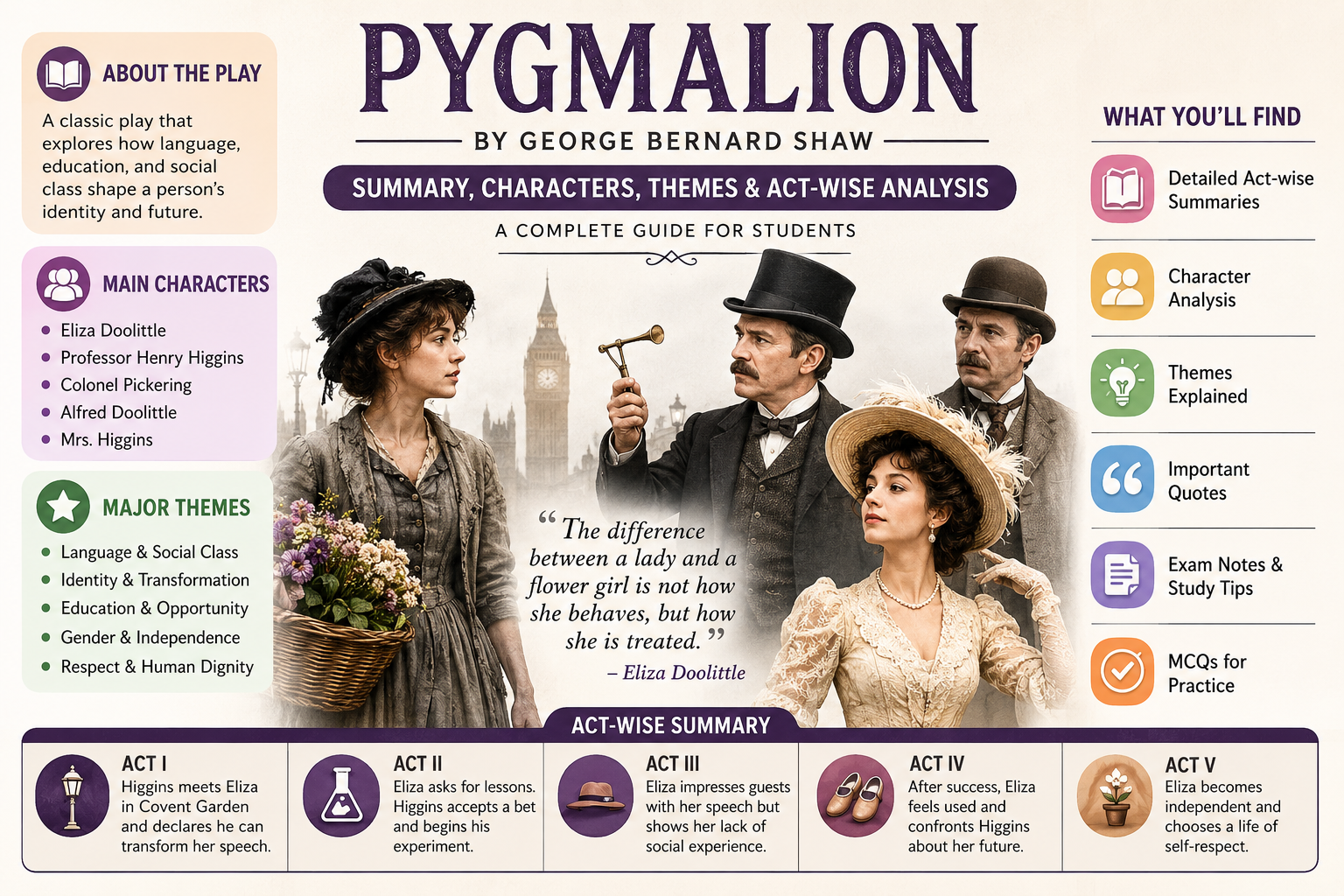
Pygmalion by George Bernard Shaw is one of the most important plays in English literature. It explores how language, education, and social class influence a person’s identity. The play follows the transformation of Eliza Doolittle, a poor flower seller, into a refined lady through speech training by Professor Henry Higgins. However, Shaw shows that true transformation is about self-respect and independence rather than appearance alone.
Whether you’re preparing for university exams, competitive tests, or classroom discussions, this guide explains the play in simple language.
Who Was George Bernard Shaw?
George Bernard Shaw was an Irish playwright, critic, and essayist who became one of the greatest dramatists in English literature. Born in Dublin in 1856, Shaw was famous for combining humor with social criticism. He won the Nobel Prize in Literature in 1925 and later received an Academy Award for the screenplay adaptation of Pygmalion.
Some of his famous works include:
- Pygmalion
- Saint Joan
- Man and Superman
- Major Barbara
- Arms and the Man
Publication History of Pygmalion
The PDF explains that:
- Written in 1912
- First performed in 1913
- English premiere in 1914
- Published in 1916
- Adapted into an Oscar-winning film in 1938
The Myth Behind Pygmalion
The title comes from the Greek myth of Pygmalion, a sculptor who created a beautiful statue and fell in love with it. The goddess Aphrodite brought the statue to life.
Shaw reimagines this myth by making Professor Henry Higgins the “creator” who transforms Eliza Doolittle through phonetics. Unlike the myth, Eliza eventually rejects dependence on her creator and becomes an independent woman, challenging traditional ideas of male authority.
Main Characters in Pygmalion
Eliza Doolittle
Eliza begins as a poor flower girl with a Cockney accent. Throughout the play, she develops confidence, self-respect, and independence, making her the central symbol of personal growth.
Professor Henry Higgins
A brilliant phonetics expert, Higgins believes language determines social status. Although intellectually gifted, he often treats Eliza like an experiment rather than a person.
Colonel Pickering
Pickering supports Higgins’s experiment but differs greatly in personality. His kindness and respectful treatment help Eliza gain confidence and dignity.
Alfred Doolittle
Eliza’s father provides comic relief while criticizing society’s ideas about poverty and morality.
Mrs. Higgins
Mrs. Higgins serves as the voice of wisdom, repeatedly reminding Higgins that Eliza is a human being with emotions and a future.
Major Themes of Pygmalion
Language and Social Class
One of Shaw’s central arguments is that speech influences how society judges individuals. Higgins believes changing pronunciation can completely alter social status. The preface also emphasizes that language often becomes a source of discrimination.
Identity
As Eliza changes her speech, she begins questioning her own identity. She no longer belongs comfortably to either the lower or upper class.
Education and Transformation
Education gives Eliza opportunities, but it also creates emotional challenges. Shaw argues that transformation involves character and confidence, not just pronunciation.
Gender and Independence
Unlike the original myth, Eliza refuses to remain dependent on Higgins. She chooses dignity, independence, and self-respect over submission.
Below is an expanded, SEO-friendly version of the Act-wise Summary section. It is based on the content provided in your PDF and written in a way that is useful for students preparing for exams while also improving search engine visibility.
Act I Summary: The Beginning of Eliza’s Transformation
Act I opens on a rainy evening in Covent Garden, where people from different social classes gather outside St. Paul’s Church while waiting for the rain to stop. George Bernard Shaw immediately introduces one of the play’s central themes—social class and language—by bringing together wealthy and poor characters in the same location. The rain acts as a dramatic device that forces strangers from different backgrounds to interact with one another.
Among the crowd is Eliza Doolittle, a poor flower seller with a strong Cockney accent. She earns her living by selling flowers to passersby. Although she belongs to the lower class, Eliza values her dignity and repeatedly insists that she is “a respectable girl.” Shaw uses her character to show that poverty does not mean a lack of self-respect.
At the same time, the audience meets the Eynsford-Hill family, whose behavior reveals the attitudes of the upper class. Freddy unsuccessfully searches for a taxi while his mother and sister criticize him for failing to solve their problem. Their dependence on servants and public transport highlights the comfort and privilege enjoyed by the upper classes.
The most important character introduced in this act is Professor Henry Higgins, an expert in phonetics who is secretly recording people’s speech patterns. His unusual behavior causes panic when some people mistake him for a police informer. Higgins quickly explains that he is not interested in crime but in studying accents and pronunciation. He impresses everyone by accurately identifying where people come from simply by listening to the way they speak. This remarkable ability establishes phonetics as the central idea of the play.
Another significant moment occurs when Higgins meets Colonel Pickering, another expert in phonetics. Both men have long admired each other’s work and quickly become friends. Their meeting becomes the foundation for the experiment that drives the entire story.
While listening to Eliza’s speech, Higgins confidently declares that her poor pronunciation will keep her trapped in poverty. He boldly claims that within a few months he could train her to pass as a duchess at an ambassador’s garden party. This statement introduces the central conflict of the play and demonstrates Shaw’s belief that language strongly influences social status.
Although Higgins displays extraordinary intelligence, Shaw also reveals his major weakness. Higgins insults Eliza by saying that someone who speaks like her “has no right to live.” His harsh words reveal his arrogance, emotional insensitivity, and tendency to value language more than people. Yet, before leaving, he unexpectedly throws money into Eliza’s basket. His generosity is mixed with pride and superiority, making him a complex character rather than a simple hero.
The act ends symbolically. Eliza discovers the money and is thrilled because it gives her opportunities she has never imagined. When Freddy finally returns with a taxi, Eliza confidently hires it herself and proudly announces that she is going home in a cab. This small moment foreshadows the much greater social transformation that is about to begin.
Key Themes in Act I
- Language as a symbol of social class
- Class discrimination
- Opportunity and transformation
- Human dignity despite poverty
- Science of phonetics
Importance of Act I
Act I introduces all the major characters, establishes the conflict, and presents the central question of the play: Can changing the way a person speaks completely transform their life?
Act II Summary: The Beginning of Higgins’s Experiment
Act II shifts to Professor Higgins’s laboratory, a room filled with phonetic instruments, diagrams, and recording equipment. The scientific atmosphere immediately emphasizes that Higgins approaches language as an exact science rather than an art. His laboratory reflects his obsession with speech analysis and reinforces his identity as a brilliant but unconventional scholar.
Colonel Pickering visits Higgins to discuss phonetics when Eliza unexpectedly arrives. She has cleaned herself as much as possible and wears her best clothes despite her poverty. Eliza boldly asks Higgins to teach her proper English because she believes improved pronunciation will help her secure employment in a respectable flower shop. Unlike many literary heroines, Eliza actively seeks to improve her own life instead of waiting for someone else to rescue her.
Initially, Higgins dismisses her rudely. However, Eliza surprises him by offering to pay for her lessons. Higgins humorously calculates that her small payment actually represents a significant part of her income, highlighting the vast economic differences between social classes. Pickering then proposes a challenge: Higgins should train Eliza until she can successfully pass as a duchess in high society. Higgins eagerly accepts, turning Eliza into the subject of a scientific experiment.
As preparations begin, Higgins treats Eliza more like an object than a person. He orders her clothes to be burned, instructs his servants to clean her thoroughly, and makes decisions about her future without asking for her opinion. His housekeeper, Mrs. Pearce, questions whether Higgins has considered what will happen to Eliza after the experiment. She becomes the moral voice of the play by reminding Higgins that human lives cannot simply be treated as scientific projects.
The arrival of Alfred Doolittle, Eliza’s father, adds another layer of social criticism. Rather than acting as a caring parent, Doolittle attempts to persuade Higgins to give him money. He openly describes himself as one of the “undeserving poor” and argues that society unfairly judges people based on appearances and respectability. Higgins finds his honesty entertaining and rewards him with money, creating one of the play’s funniest yet most thought-provoking scenes.
By the end of the act, Eliza has been cleaned, dressed in elegant clothes, and introduced to a much more comfortable lifestyle. Although her appearance changes dramatically, her speech and behavior still reveal her working-class background. Shaw emphasizes that genuine transformation requires education, discipline, and confidence—not merely attractive clothing.
Key Themes in Act II
- Education as a means of social mobility
- Scientific experimentation
- Human dignity
- Class inequality
- Responsibility toward others
Importance of Act II
This act officially begins Higgins’s experiment and highlights the contrast between Higgins’s intellectual brilliance and his emotional blindness. It also establishes Eliza’s determination to improve her future through hard work.
Act III Summary: Eliza Faces High Society
Act III takes place in Mrs. Higgins’s drawing room, where Higgins plans the first public test of Eliza’s progress. Before the guests arrive, Mrs. Higgins warns her son that proper pronunciation alone cannot make someone a true lady. Good manners, emotional intelligence, and appropriate conversation are equally important. Higgins ignores this advice because he believes language alone determines social success.
When Eliza enters, her appearance and pronunciation impress everyone. She speaks with remarkable accuracy, demonstrating how much she has learned through Higgins’s training. However, her conversation quickly reveals that she still thinks like someone from her original social environment. She casually discusses topics such as illness, death, and drinking—subjects considered inappropriate in polite society.
The guests respond differently to Eliza. Freddy becomes fascinated by her honesty and charm, while Clara admires her unusual style and even begins copying some of her expressions. Shaw humorously suggests that upper-class society often imitates what it first criticizes.
After Eliza leaves, Mrs. Higgins criticizes both Higgins and Pickering. She points out that they have spent months teaching Eliza how to speak but have completely ignored her emotional future. Once the experiment ends, where will Eliza belong? Higgins dismisses these concerns because he continues to see Eliza as a successful experiment rather than a person whose life has permanently changed.
Key Themes in Act III
- Manners versus pronunciation
- Social etiquette
- Identity crisis
- Responsibility
- Emotional intelligence
Importance of Act III
This act proves that changing language alone is not enough for complete social transformation. Shaw argues that character, behavior, and emotional maturity are equally important.
Act IV Summary: Eliza’s Emotional Awakening
Act IV occurs immediately after Eliza successfully passes as a duchess at the ambassador’s party. Higgins and Pickering celebrate their victory and congratulate themselves, but they completely ignore Eliza’s contribution. Higgins even remarks, “Thank God it’s over,” revealing that he views the experiment merely as an intellectual challenge.
Eliza, exhausted after months of intense training, silently watches as the two men discuss the evening’s success. When Higgins casually orders her to switch off the lights before leaving, she realizes that despite all her hard work, he still treats her like a servant.
Unable to control her emotions any longer, Eliza throws Higgins’s slippers at him and demands recognition for everything she has achieved. She repeatedly asks the heartbreaking question, “What’s to become of me?” She explains that she no longer belongs to her old working-class world but has not been accepted into upper-class society either.
Higgins completely fails to understand her emotional crisis. Instead of offering sympathy, he coldly suggests that she should marry someone or open a flower shop. Eliza rejects the idea of depending on marriage, proudly declaring that she sold flowers—not herself. Her statement marks one of the strongest declarations of female independence in the play.
The argument reaches its climax when Eliza returns Higgins’s ring, symbolizing the collapse of their relationship. Higgins storms out angrily, while Eliza experiences a new sense of confidence because she has finally stood up for herself.
Key Themes in Act IV
- Identity crisis
- Female independence
- Self-respect
- Gratitude and recognition
- Emotional conflict
Importance of Act IV
Many critics consider this the emotional climax of Pygmalion. Eliza transforms from Higgins’s student into an independent individual capable of making her own decisions.
Act V Summary: Independence and Self-Respect
Act V returns to Mrs. Higgins’s home, where Higgins and Pickering search for Eliza after discovering that she has left. Higgins even contacts the police, revealing that he still thinks of Eliza as someone under his control rather than an independent woman. Mrs. Higgins strongly criticizes this attitude.
Meanwhile, Alfred Doolittle reappears, but his circumstances have changed dramatically. Higgins unintentionally transformed him into a wealthy gentleman, forcing him to live according to middle-class expectations. This ironic reversal reinforces Shaw’s idea that social change often brings unexpected responsibilities.
When Eliza finally appears, she is calm, confident, and emotionally mature. Her greatest transformation is no longer her accent but her personality. She explains that Colonel Pickering’s respectful treatment gave her confidence, while Higgins’s constant criticism prevented her from feeling valued. According to Eliza, the difference between a flower girl and a lady lies not in appearance or speech but in how she is treated by others.
Eliza refuses to return to her former life and also refuses to remain dependent on Higgins. She plans to teach phonetics and support herself independently. Higgins is surprised by her confidence and, ironically, begins respecting her only after she challenges his authority.
The epilogue explains that Eliza eventually marries Freddy rather than Higgins because Freddy offers kindness, love, and equality. Together they run a flower shop with Pickering’s assistance, demonstrating that true success lies in independence and mutual respect rather than wealth or social status.
Key Themes in Act V
- Independence
- Respect and dignity
- Emotional maturity
- Class and identity
- Equality
Importance of Act V
The final act delivers Shaw’s central message: true transformation is measured by self-respect, confidence, and independence—not by accent, clothing, or social class. It completes Eliza’s journey from a poor flower seller into a self-reliant and confident woman while reinforcing the play’s critique of class, gender, and social responsibility.
Why Is Pygmalion Still Relevant?
Although written over a century ago, Pygmalion remains relevant because it explores issues that continue to shape society:
- Accent-based discrimination
- Equal educational opportunities
- Gender equality
- Self-respect and identity
- Social prejudice
These themes make the play valuable for both literature students and modern readers.
Frequently Asked Questions
What is the main theme of Pygmalion?
The play explores language, identity, class, and personal transformation, showing how speech affects social opportunities while emphasizing that respect and character matter more than appearance.
Why does Higgins train Eliza?
He accepts a challenge to transform her speech so she can pass as a duchess in high society.
Why doesn’t Eliza marry Higgins?
According to the epilogue, Shaw rejects a conventional romantic ending. Eliza chooses Freddy because he offers emotional warmth and equality, while Higgins remains emotionally detached.
What is the significance of language in the play?
Language functions as a marker of class and opportunity. Shaw argues that pronunciation can influence how society judges individuals.
What lesson does Pygmalion teach students?
The play teaches that education can create opportunities, but true personal growth requires dignity, respect, empathy, and independence.
Conclusion
Pygmalion is much more than the story of a flower girl learning proper English. It is a powerful exploration of identity, education, class, and human dignity. Through Eliza Doolittle’s journey, George Bernard Shaw demonstrates that lasting transformation comes not only from changing the way people speak but also from gaining confidence, self-respect, and independence.
This article is optimized for keywords such as Pygmalion summary, Pygmalion themes, Pygmalion character analysis, Act-wise summary of Pygmalion, George Bernard Shaw Pygmalion notes, and Pygmalion exam guide, making it useful for both search engines and students.