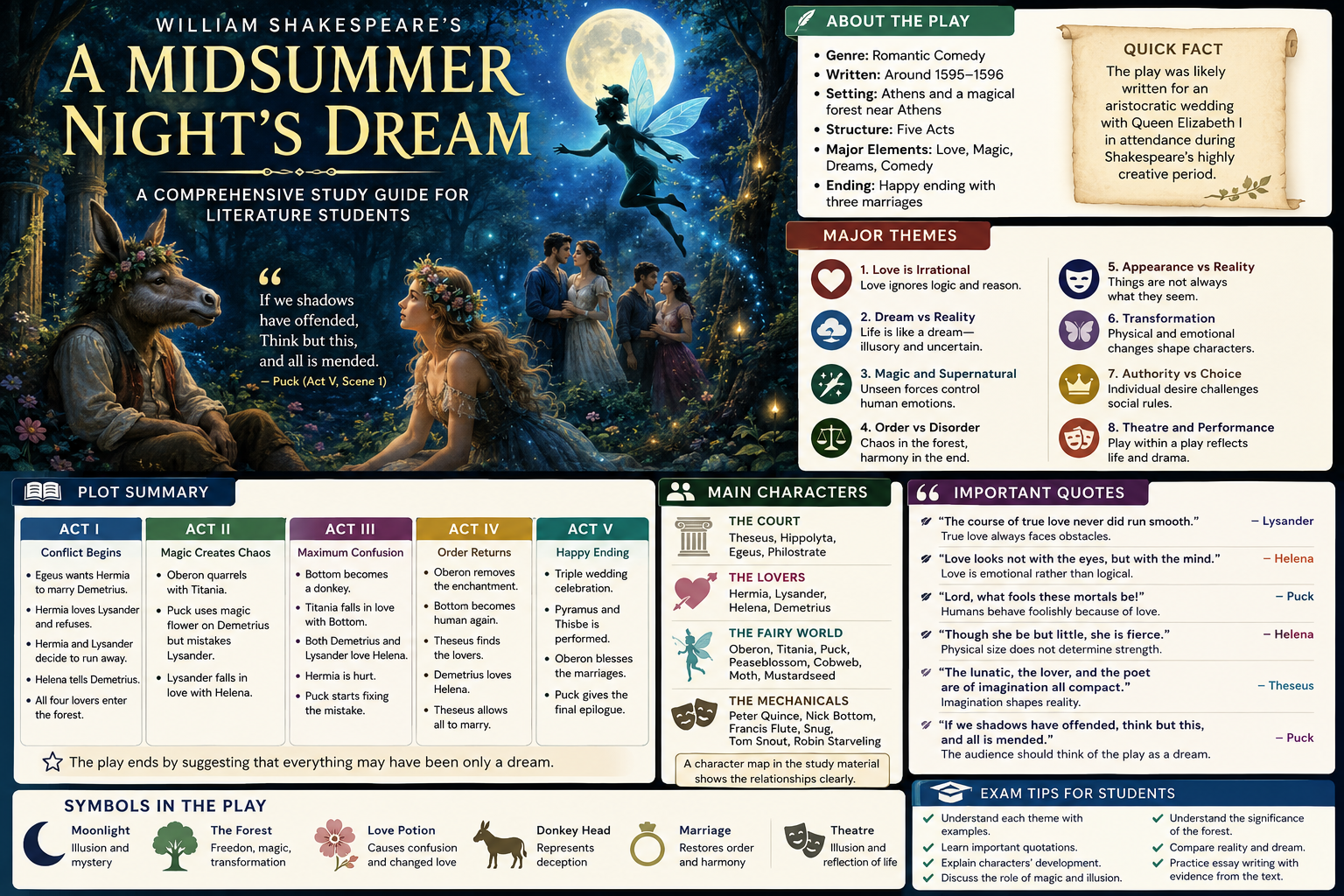
A Midsummer Night’s Dream complete study guide for literature students covering summary, characters, themes, important quotes, symbolism, and exam preparation tips in an easy-to-understand format.
Literature Student Must Know
This study guide is based on the uploaded lecture notes and Shakespeare’s play, providing a structured resource for literature students.
A Midsummer Night’s Dream Study Guide
William Shakespeare’s A Midsummer Night’s Dream is one of the most celebrated romantic comedies in English literature. Written around 1595–1596, the play blends romance, fantasy, comedy, and magic into a fascinating story of mistaken identities and supernatural intervention. It explores timeless themes such as love, imagination, dreams, authority, and transformation.
Whether you are preparing for university exams, competitive literature tests, or classroom discussions, this guide provides everything you need in one place.
Quick Facts About the Play
- Author: William Shakespeare
- Genre: Romantic Comedy
- Written: Around 1595–1596
- Setting: Athens and a magical forest near Athens
- Structure: Five Acts
- Major Elements: Love, Magic, Dreams, Comedy
- Ending: Happy ending with three marriages and restored harmony
The play was likely written for an aristocratic wedding during Shakespeare’s highly creative period.
Plot Summary
Act I – Conflict Begins
The play opens in Athens, where Duke Theseus prepares to marry Hippolyta.
Major events include:
- Egeus demands Hermia marry Demetrius.
- Hermia refuses because she loves Lysander.
- Theseus gives Hermia three choices:
- Marry Demetrius
- Become a nun
- Face death
- Hermia and Lysander decide to escape.
- Helena secretly tells Demetrius about their plan.
This decision leads all four lovers into the enchanted forest.
Act II – Magic Creates Chaos
Inside the forest:
- Oberon quarrels with Titania.
- The conflict concerns the changeling boy.
- Oberon orders Puck to use a magical flower.
- Puck mistakenly enchants Lysander instead of Demetrius.
- Lysander suddenly falls in love with Helena.
This mistake becomes the turning point of the play.
Act III – Maximum Confusion
Important events include:
- Bottom is transformed into a donkey.
- Titania falls in love with Bottom.
- Both Lysander and Demetrius love Helena.
- Hermia is abandoned.
- The lovers argue and nearly fight.
- Puck finally begins correcting his mistake.
Comedy reaches its highest point in this act.
Act IV – Order Returns
Key developments:
- Oberon removes Titania’s enchantment.
- Bottom becomes human again.
- Theseus discovers the lovers.
- Demetrius remains in love with Helena.
- Theseus allows all lovers to marry.
Everything begins to return to normal.
Act V – Happy Ending
The final act features:
- Triple wedding celebration.
- Performance of Pyramus and Thisbe.
- Comic entertainment by the mechanicals.
- Oberon blesses the marriages.
- Puck delivers the famous epilogue.
The play ends by suggesting everything may simply have been a dream.
Main Characters
The Court
- Theseus
- Hippolyta
- Egeus
- Philostrate
The Lovers
- Hermia
- Lysander
- Helena
- Demetrius
The Fairy World
- Oberon
- Titania
- Puck
- Peaseblossom
- Cobweb
- Moth
- Mustardseed
The Mechanicals
- Peter Quince
- Nick Bottom
- Francis Flute
- Snug
- Tom Snout
- Robin Starveling
A character map in the uploaded notes visually connects these relationships.
Major Themes
1. Love is Irrational
Love ignores logic.
Examples include:
- Helena loves Demetrius despite rejection.
- Titania loves Bottom under magic.
- Lysander suddenly changes affection.
Key Point:
- Love follows emotion rather than reason.
2. Dream vs Reality
The forest becomes a dream-like world.
Important ideas:
- Reality becomes uncertain.
- Characters believe events were dreams.
- Puck encourages the audience to think the play itself was only a dream.
3. Magic and Supernatural Power
Magic changes human emotions.
Examples:
- Love potion
- Fairy intervention
- Puck’s tricks
Magic drives nearly every conflict in the play.
4. Order vs Disorder
Beginning:
- Conflict
- Confusion
- Forced marriage
Ending:
- Peace
- Marriage
- Social harmony
5. Appearance vs Reality
Characters repeatedly misunderstand what they see.
Examples include:
- Titania admires Bottom’s donkey head.
- Lovers mistake magical emotions for genuine love.
6. Transformation
Transformation occurs physically and emotionally.
Examples:
- Bottom becomes a donkey.
- Titania changes emotionally.
- Lovers’ feelings shift throughout the story.
7. Authority vs Individual Choice
Important conflict:
- Egeus represents authority.
- Hermia represents personal freedom.
The play questions whether parents should control marriage.
8. Theatre and Performance
The play includes a famous play within a play.
Functions include:
- Comic entertainment
- Satire
- Reflection on acting itself
Important Quotes for Exams
“The course of true love never did run smooth.”
Speaker: Lysander
Meaning:
- True love always faces obstacles.
“Love looks not with the eyes, but with the mind.”
Speaker: Helena
Meaning:
- Love is emotional rather than logical.
“Lord, what fools these mortals be!”
Speaker: Puck
Meaning:
- Humans behave foolishly because of love.
“Though she be but little, she is fierce.”
Meaning:
- Physical size does not determine strength.
“The lunatic, the lover, and the poet are of imagination all compact.”
Speaker: Theseus
Meaning:
- Imagination shapes reality.
“If we shadows have offended…”
Speaker: Puck
Meaning:
- The audience should think of the play as a dream.
These quotations are highlighted throughout the uploaded study material.
Symbols in the Play
Major symbols include:
- 🌙 Moonlight
- 🌳 The enchanted forest
- 💐 Love potion
- 🫏 Bottom’s donkey head
- 💍 Marriage
- 🎭 Theatre
Each symbol reinforces the central ideas of illusion, imagination, and transformation.
Exam Preparation Tips
For literature examinations, remember to:
- Explain themes with textual evidence.
- Memorize key quotations.
- Understand each character’s development.
- Learn the significance of the forest.
- Practice discussing Shakespeare’s use of comedy.
- Compare reality and illusion.
- Revise the play-within-a-play technique.
- Understand Puck’s role in resolving the conflict.
Frequently Asked Questions (FAQs)
1. Why is the forest important in A Midsummer Night’s Dream?
The forest symbolizes freedom, magic, confusion, and transformation. Characters leave the orderly world of Athens and experience emotional and supernatural change.
2. Why does Titania fall in love with Bottom?
Oberon uses a magical flower to enchant Titania, causing her to fall in love with the first creature she sees—Bottom with a donkey’s head.
3. Who causes the confusion among the lovers?
Puck mistakenly applies the love potion to Lysander instead of Demetrius, creating the central conflict.
4. What is the significance of Pyramus and Thisbe?
The play-within-the-play humorously mirrors the lovers’ story while parodying tragic romance.
5. What is the main message of the play?
Shakespeare suggests that love is unpredictable, imagination is powerful, and harmony eventually triumphs over confusion.
6. Why is Puck considered the most memorable character?
Puck combines humor, mischief, magic, and wisdom. His famous closing speech reminds audiences that theatre itself is a kind of dream.
Conclusion
A Midsummer Night’s Dream remains one of Shakespeare’s most engaging and frequently studied plays because it combines romance, fantasy, comedy, and philosophical reflection. Through unforgettable characters, magical events, and timeless themes, Shakespeare demonstrates that love rarely follows reason and that imagination has the power to reshape reality. For literature students, mastering the play’s characters, themes, symbols, and key quotations is essential for achieving success in examinations and developing a deeper appreciation of Shakespeare’s artistry
Also Read: Julius Caesar by William Shakespeare: Complete Study Guide, Sources, Themes & Important Notes